Offset vs Crane Handle Hair Shears: Which Fights Fatigue Better?
Ask any stylist who has spent fifteen years behind the chair which part of their body complains loudest at the end of a long day, and you'll hear the same answer again and again: the thumb, the wrist, the shoulder. Repetitive strain isn't a rumor in this profession — it's the price most stylists pay for a decade of ten-hour shifts on their feet. Handle geometry is one of the few variables you actually control, and the two dominant designs — offset and crane — exist for exactly one reason: to reduce the angle your thumb and elbow must open to make a clean cut. Choose the right one for your cutting style and you can add years to your career. Choose the wrong one and you'll fight the tool every time you pick it up.
This article unpacks the real mechanical difference between an offset handle and a crane handle, when each one outperforms the other, and which Saki shears match each design. If you're shopping for your next pair, the Saki Katana cutting shears use the offset-with-extended-crane geometry that most working stylists adopt once they've tried it — that's the reference point we'll come back to throughout the comparison.
Why Handle Design Matters More Than You Think
The Bureau of Labor Statistics and multiple occupational-health studies put hairdressing in the top tier of jobs for cumulative upper-limb disorders. The National Institute for Occupational Safety and Health (NIOSH) notes that repeated deviation of the wrist and shoulder — especially in combination with sustained grip force — is a primary driver of musculoskeletal injury. A hair shear that forces your thumb, wrist, or elbow into a non-neutral position 200 times a haircut is compounding that load every minute you work.
The two modern handle designs most professional shears use today — offset and crane — both exist to correct a flaw in the classical symmetrical "opposing-grip" handle. Opposing-grip shears force the thumb and ring-finger rings to sit directly across from each other. That looks symmetrical, but it forces the hand into a position where the thumb has to bend deeply inward while the elbow flares out. Offset and crane handles each solve that problem in a different way.
Offset Handles: The Foundation of Modern Ergonomics
An offset handle shifts the thumb ring toward you, so the thumb sits shorter and lower than the finger ring. The practical effect is that the thumb doesn't have to reach as far to open the blades. Instead of your thumb doing most of the travel, the fingers and thumb meet roughly halfway. Your wrist stays closer to neutral, and the elbow can drop toward the body rather than flaring out to the side.
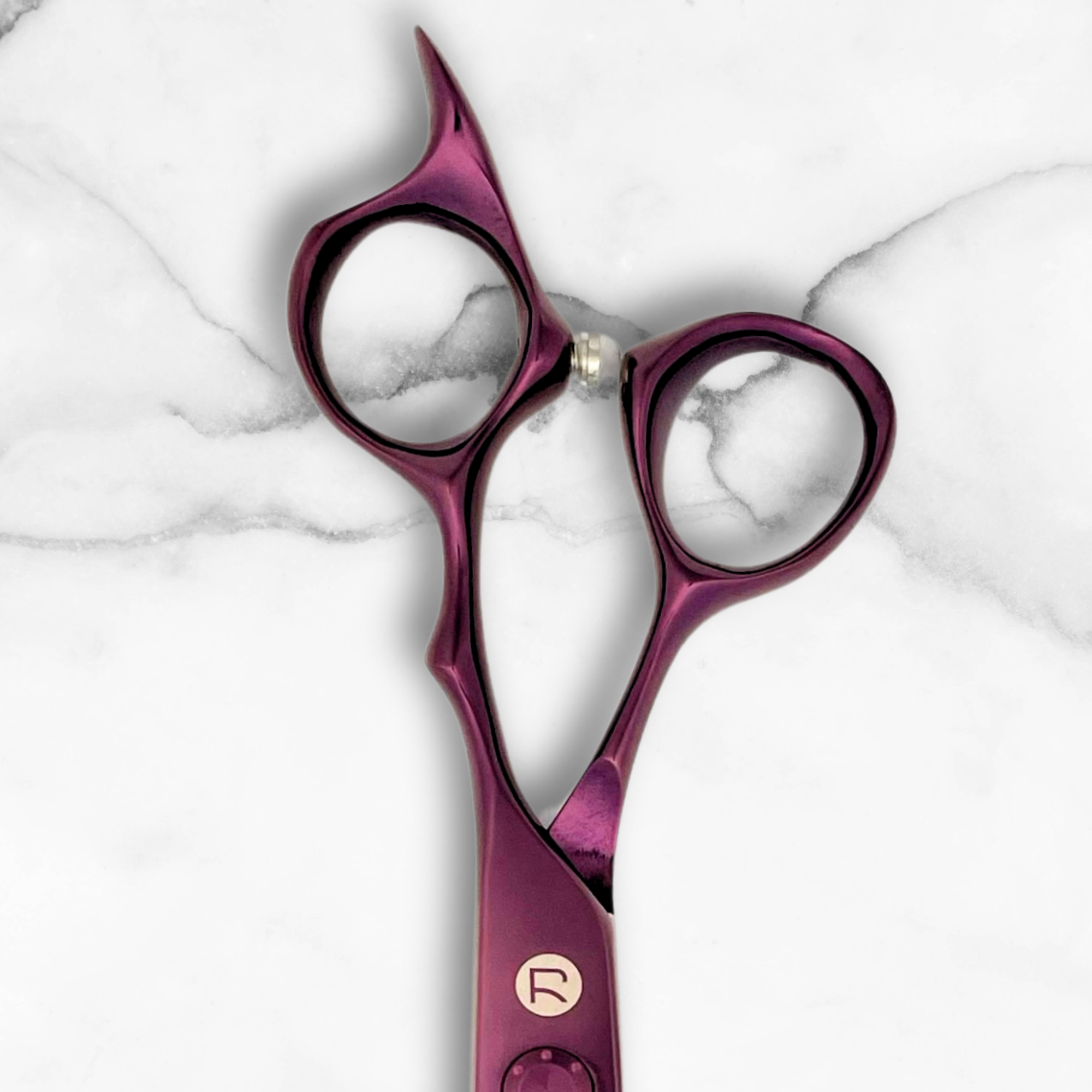
In a pure offset, the thumb ring sits farther back on the shank, but the rings remain roughly parallel to the blade line. This is the starting point for nearly every "ergonomic" shear on the market. You'll recognize it by the visibly shorter thumb arm and the slight angle between the two rings when the shears sit flat on a table.
The strengths of a pure offset are subtle but add up across a shift: less thumb fatigue, less wrist deviation, and a more natural elbow position during blunt cuts, club cuts, and most perimeter work. The weakness is that for elevated or overhead cutting — lifting and sectioning long hair, cutting at a raised angle — a pure offset still requires the shoulder to rise higher than is ideal, because the handle geometry doesn't relieve the shoulder the way a crane does.
Crane Handles: Built for the Shoulder and Elbow
A crane handle takes offset one step further. The thumb ring is both shifted and angled downward — the entire thumb arm rakes away from the blade line. Hold a crane shear flat on a table and the thumb ring sits noticeably below the plane of the finger ring.
That downward rake does something specific: it drops the elbow and shoulder toward the body during cutting. When you hold an elevated section of hair with your non-dominant hand at eye level and bring the shears up to it, a standard offset forces the elbow out to the side to keep the blades horizontal. A crane handle lets you keep your elbow lower and tucked, because the angled thumb ring compensates for the lift.
Crane shears are particularly valuable for stylists who:
- Do a lot of elevated cutting (long-hair layering, graduated bobs, classic men's scissor-over-comb work)
- Have existing shoulder or upper-back discomfort
- Cut with their cutting hand frequently raised above chest level
- Are taller than the average salon chair was designed for
The downside of a pure crane is that the aggressive angle can feel unfamiliar at first. Stylists trained exclusively on symmetrical or mild-offset handles often report that a deep crane feels "tilted" for the first few days. The feeling passes once the hand adapts to the new neutral position, but it's a legitimate adjustment period.
Offset Plus Crane: The Hybrid Most Working Stylists Actually Use
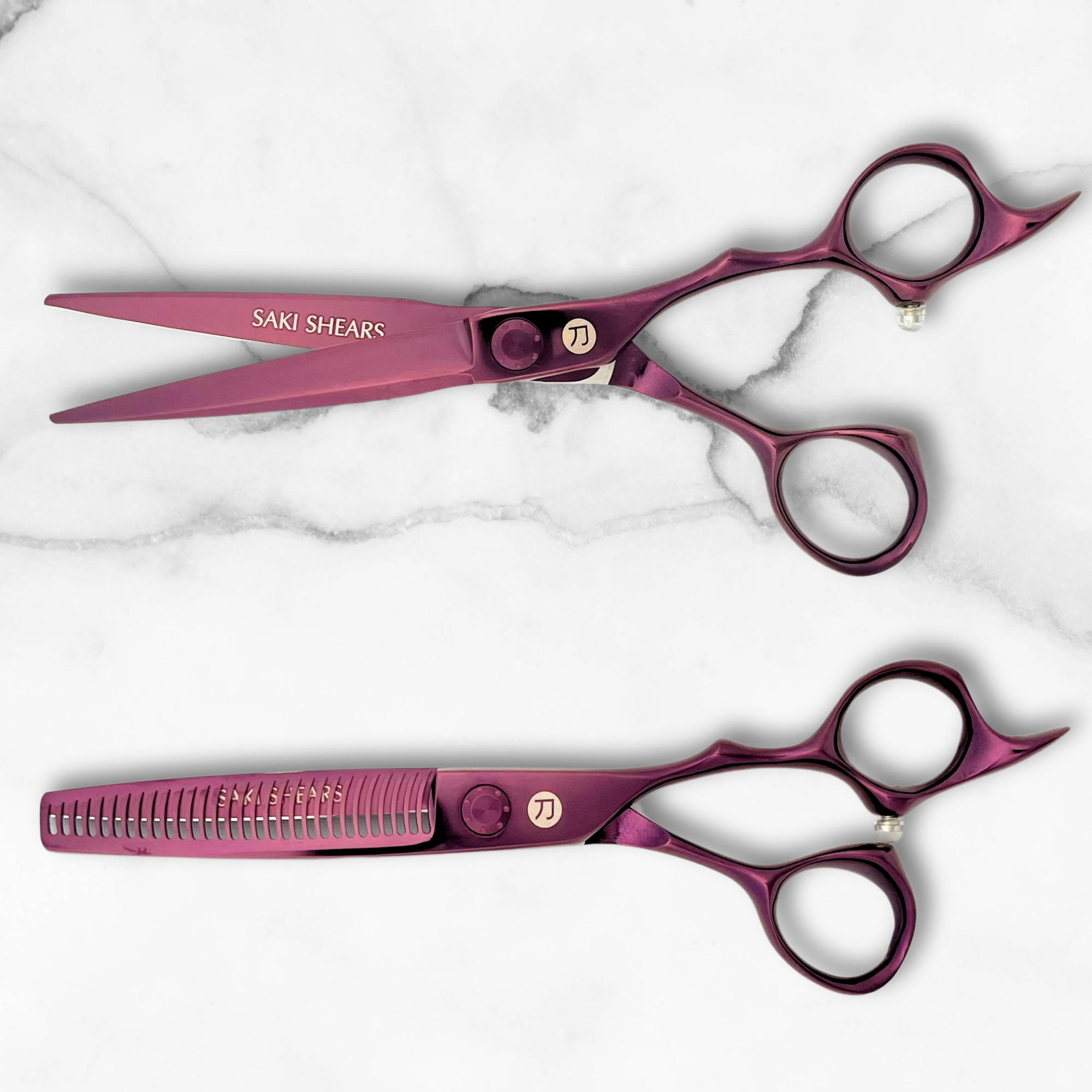
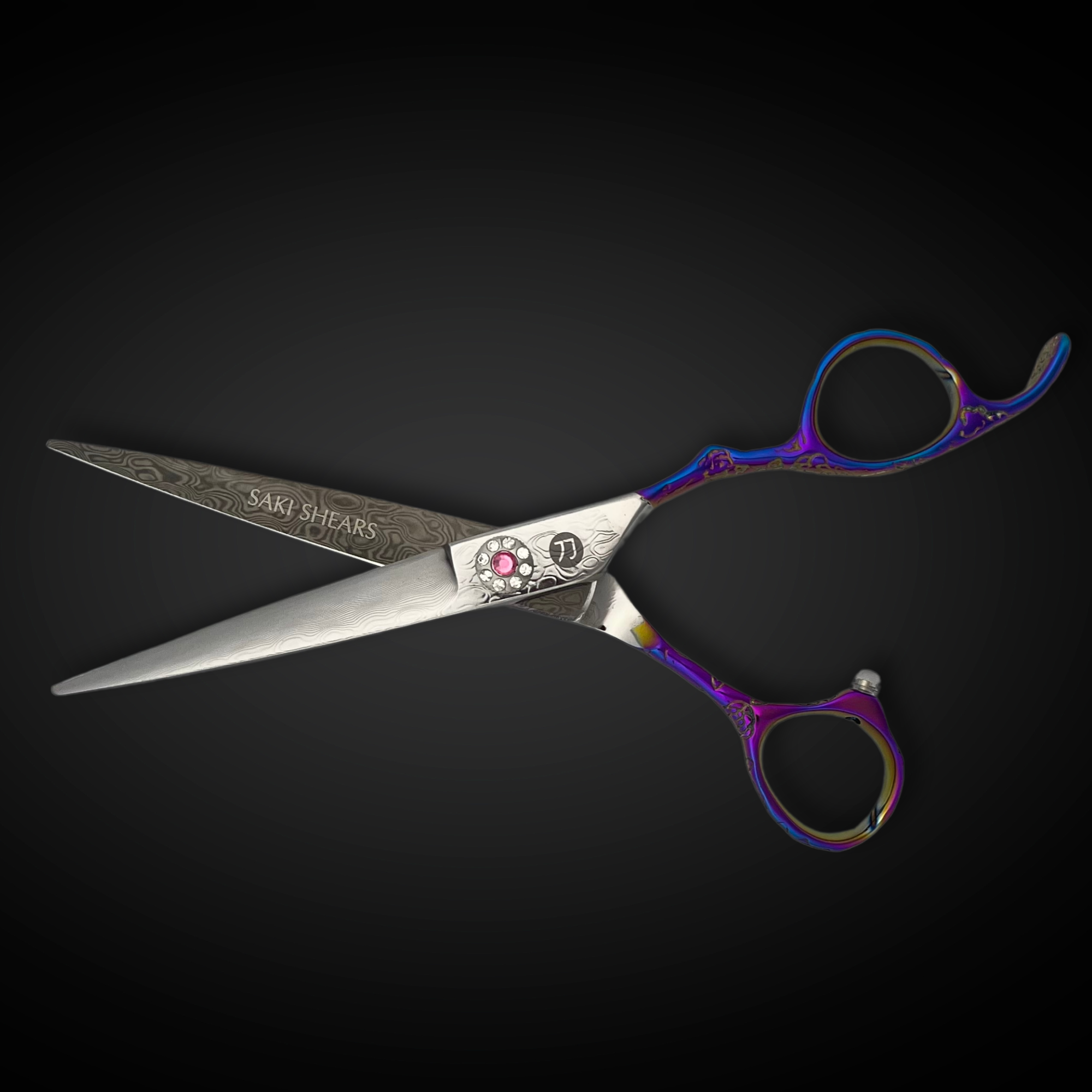
Here's the part most handle comparisons skip: the modern standard on mid-to-premium Japanese shears is not a pure offset or a pure crane. It's a hybrid — an offset thumb ring with an extended, slightly-angled crane shank. You get the thumb relief of the offset plus the shoulder relief of the crane, without the extreme downward rake that makes pure-crane shears feel strange on the first day.
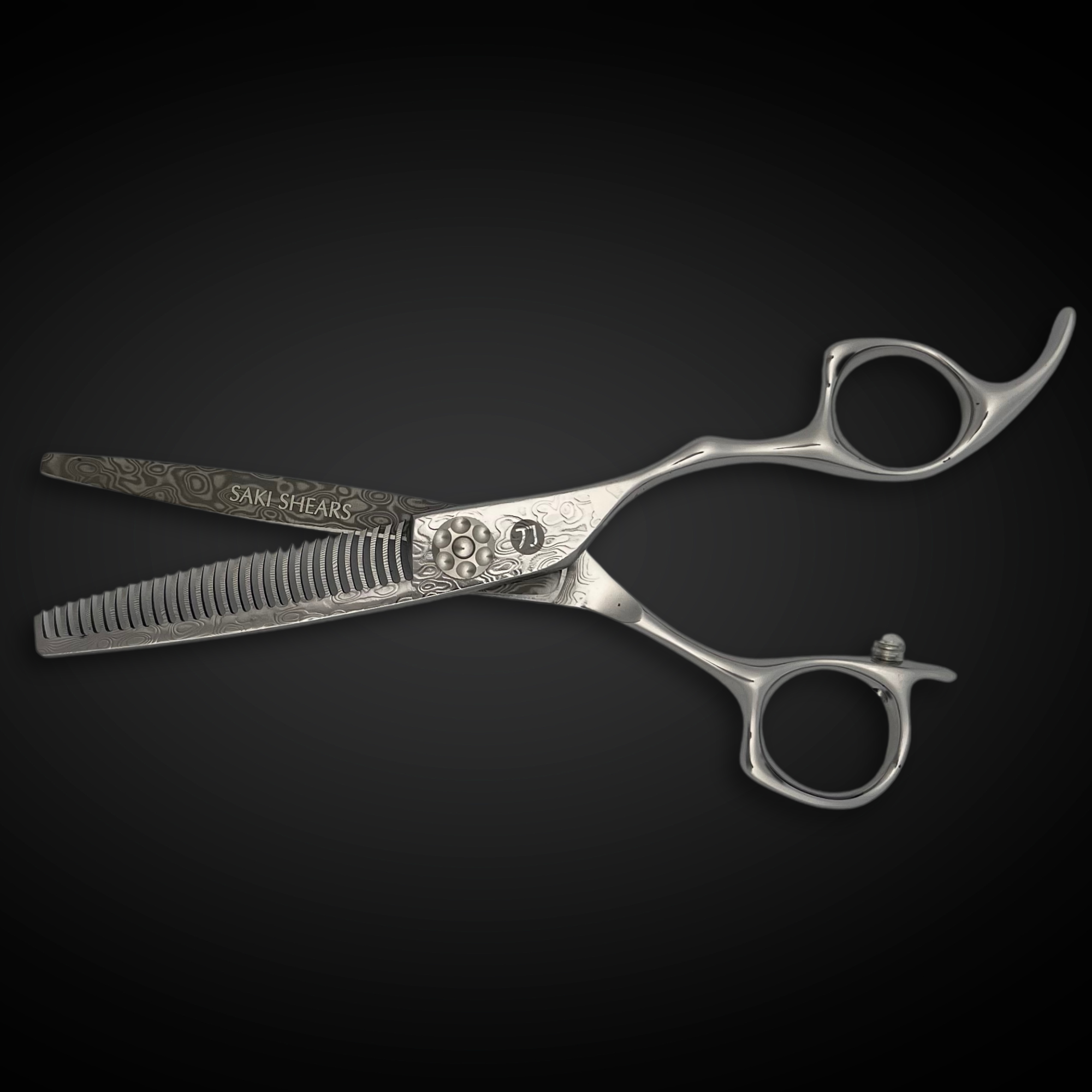
The Saki Katana is built this way. Its thumb ring is offset for neutral wrist position during perimeter work, and the shank is lengthened and slightly cranked to keep the elbow low when the hand rises for elevated sections. Most stylists who try the Katana describe the handle as "just comfortable" — which is the goal. A handle you stop noticing is a handle that's doing its job.
The Saki Kotaro uses a similar offset-plus-crane geometry at a different price point, with a slightly wider finger ring that suits stylists with larger hands or who prefer a fuller grip. Both shears sit in the sweet spot that most experienced cutters settle on after experimenting with several handle styles. For a closer look at how that geometry performs across a full day of cutting, see our in-depth review of the Saki Kotaro.

Swivel Thumbs: When Even a Crane Isn't Enough
If you already have symptoms of carpal tunnel, De Quervain's tenosynovitis, or chronic thumb-base pain, a static crane handle may not be sufficient. This is where swivel-thumb shears enter the conversation. A swivel handle rotates independently of the thumb ring, so no matter where your hand moves, the thumb stays in a neutral position.
The Saki Sakura Swivel is the Saki answer for stylists who need active fatigue protection. The swivel design makes the thumb a passive participant — it doesn't have to rotate with the wrist. For stylists returning from a repetitive-strain injury, or for anyone regularly cutting 35-plus hours a week, a swivel is often the difference between retiring early and working another decade comfortably.
The trade-off is adjustment time. Swivel shears feel genuinely different for the first week, and some stylists don't find the benefit worth the learning curve. If you're at the "curious" stage rather than the "my hand hurts every night" stage, a well-designed offset-plus-crane like the Katana or Kotaro is almost certainly the better first upgrade.
How to Decide: A Practical Framework
Forget the marketing copy. The question to ask yourself is simple: where does your body hurt first at the end of a shift?
Thumb base, web between thumb and index finger, or wrist on the inside: You'll benefit most from an offset or offset-plus-crane handle. The thumb relief is what you need.
Shoulder, upper back, or elbow flaring outward during cuts: A crane — or better, an offset-plus-crane — will help more. The elbow relief matters most for you.
Numbness, tingling, or pain that persists after your shift ends: Don't mess around with incremental improvements. Move to a swivel-thumb design and talk to a hand specialist. A tool that costs a few hundred dollars is cheap compared to surgery and time off the floor.
No specific pain yet: Choose an offset-plus-crane. You're buying insurance, and this is the geometry that holds up across the widest range of cutting styles and client types.
Common Mistakes When Switching Handles
Stylists moving from symmetrical or shallow-offset handles to a deeper offset-plus-crane or pure crane make the same three mistakes:
Gripping too hard. The whole point of ergonomic geometry is that you shouldn't have to squeeze to hold the shears in position. If your knuckles are white, the handle isn't the problem — your grip pressure is. Relax the hand, let the thumb rest on the ring rather than push through it, and the shear will open and close with almost no force.
Keeping the finger brace (tang) up. Some stylists trained on older shears still curl their pinky underneath the handle instead of resting it on the tang. On a modern offset shear with a long tang, that wastes most of the ergonomic benefit. Rest the pinky on the tang and let it support the closing motion.
Bending the wrist to compensate. If you find yourself cocking your wrist to one side to make cuts feel familiar, you're undoing what the handle was designed to fix. Let the new geometry move the elbow and shoulder instead. The first week feels odd — then the new position becomes the default.
The research on this is well-established: ergonomics specialists at the Occupational Safety and Health Administration consistently show that even modest corrections to wrist and shoulder posture compound into meaningful injury reduction over years of repetitive work. For a stylist, "years of repetitive work" is the whole career.
Matching Handle to Blade and Length
Handle geometry doesn't exist in isolation. Pair it thoughtfully with blade length and edge type:
5.5-inch, convex edge, offset-plus-crane: The all-purpose configuration. Fits most hand sizes, works for point cutting, slide cutting, and blunt cuts. This is what the 5.5" Katana and 5.5" Kotaro are built for.
6-inch, convex edge, offset-plus-crane or crane: Barber-leaning work, men's cutting, over-comb technique. The extra reach of the 6-inch length pairs well with a more aggressive crane because elevated cutting is more common in this style.
7-inch, convex edge, crane or swivel: Long-hair specialists, scissor-over-comb on thick hair, slide cutting. The 7-inch Katana uses a crane-forward handle because 7-inch cutting is almost always done with a raised hand.
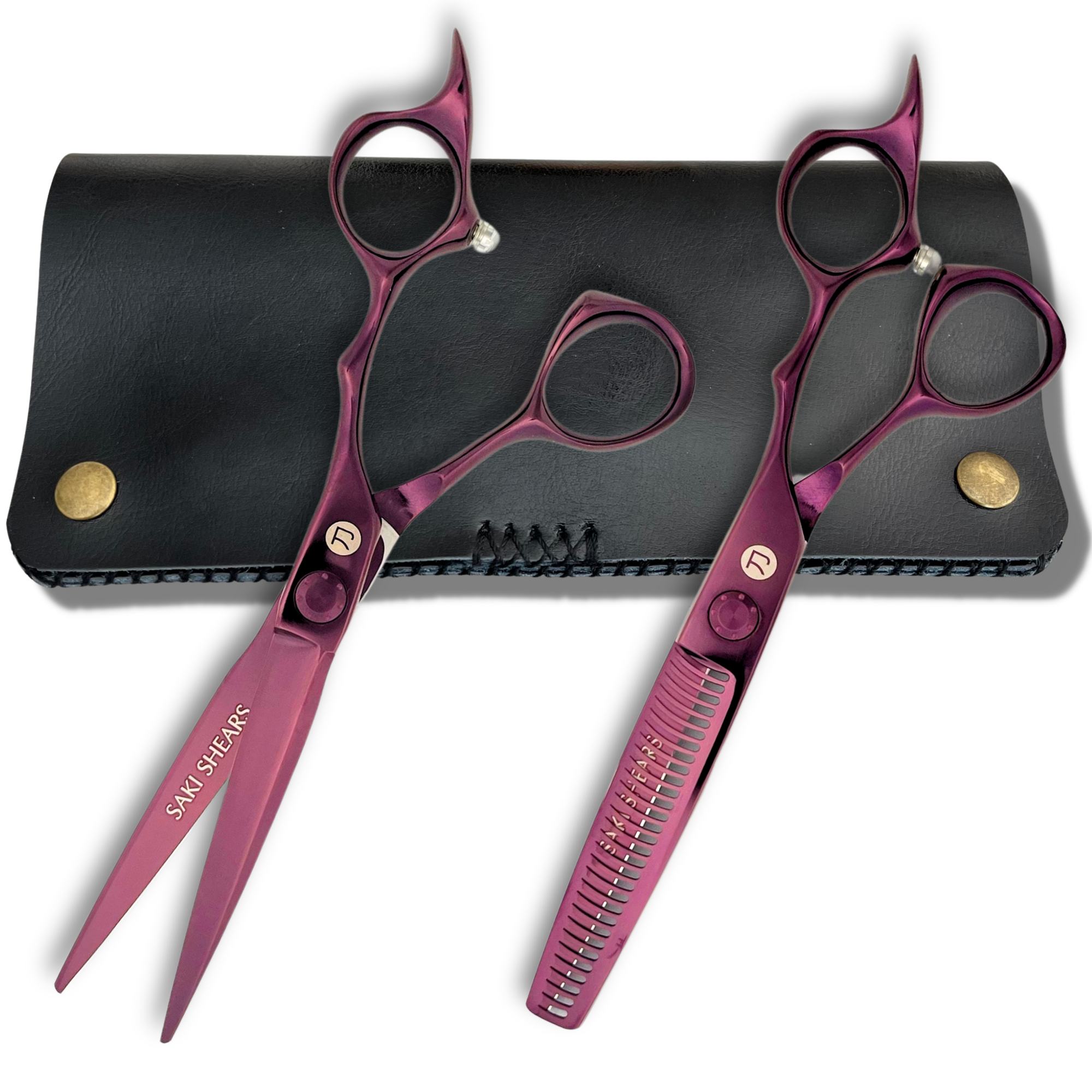
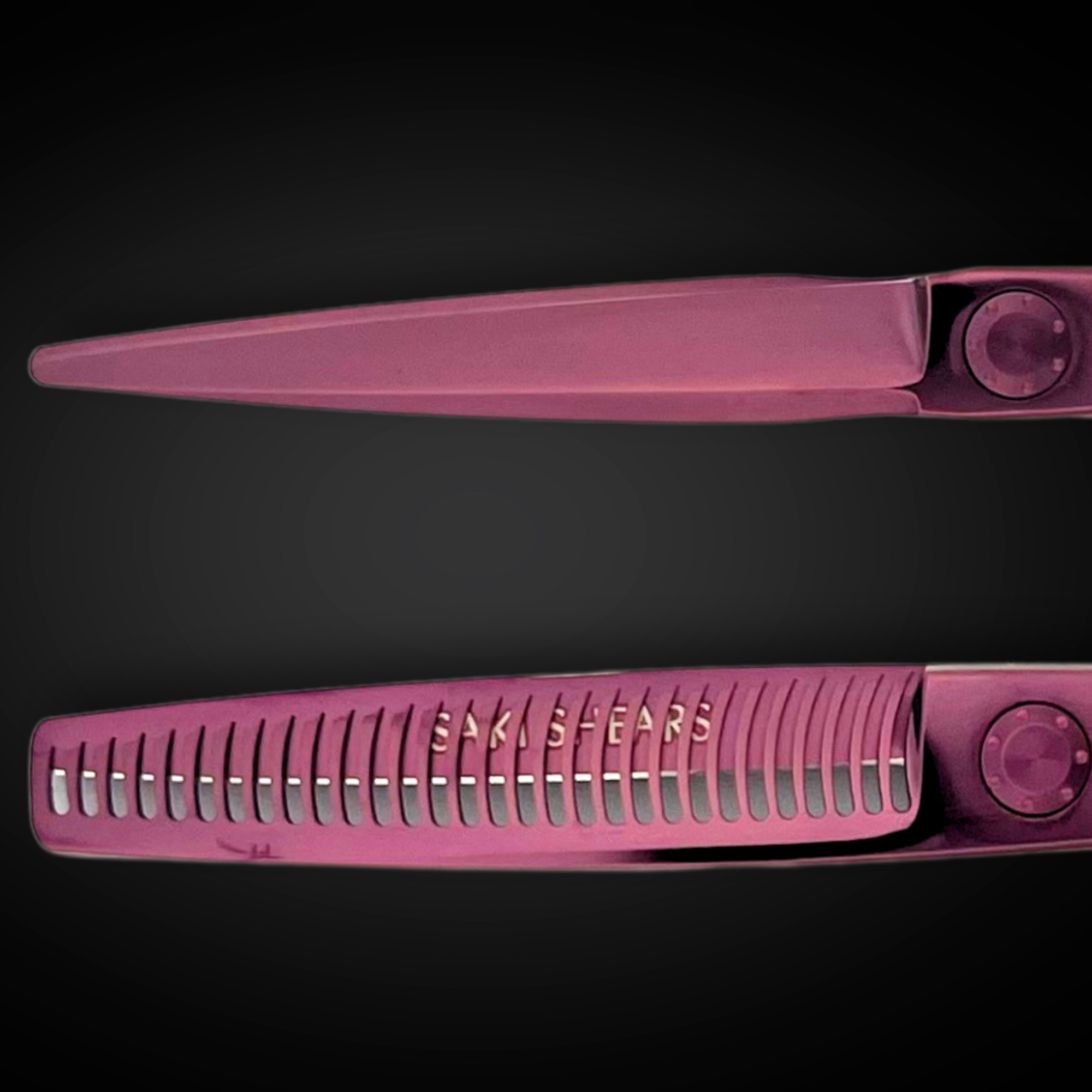
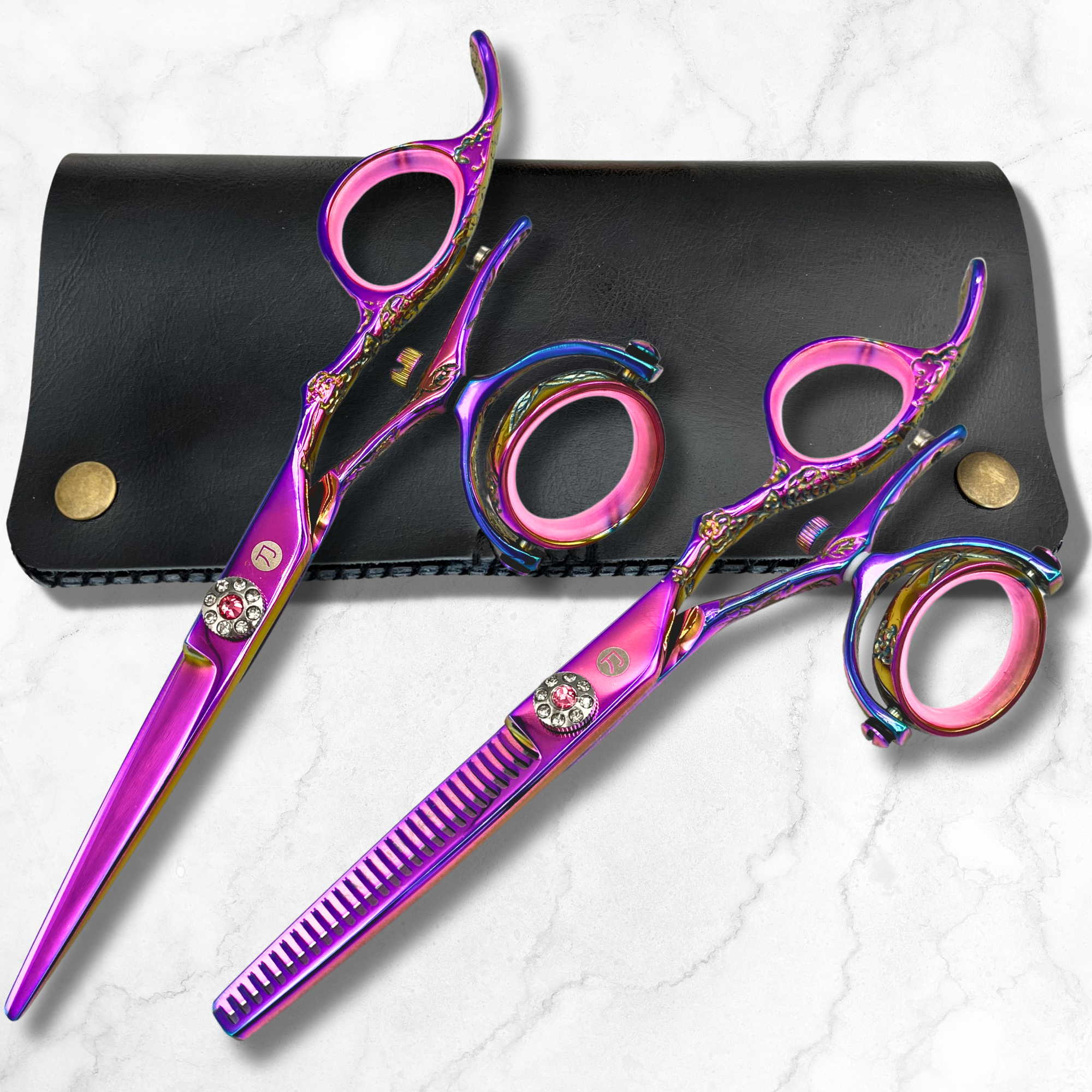
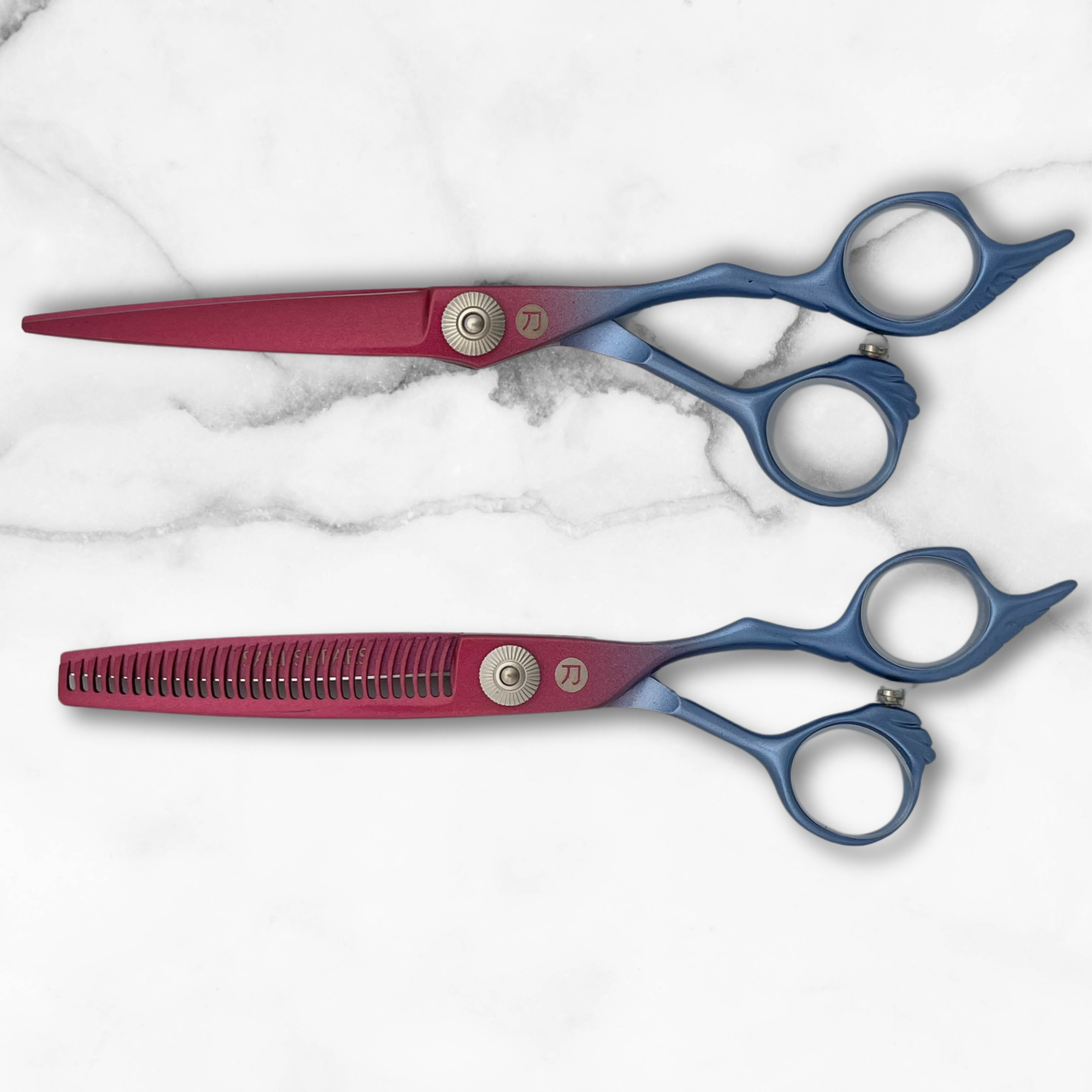
Pink titanium-coated, offset-plus-crane: The Saki Kohana set pairs titanium-coated blades with the same offset-plus-crane geometry for stylists who want corrosion resistance and a distinctive finish without giving up ergonomics. For what that coating actually is — and what the set includes for the money — see our full breakdown of the Kohana pink shears.
Care and Handle Longevity
One point rarely covered in handle comparisons: the screw that joins the two blades also determines how the handle feels in your hand. An over-tightened screw makes even the best ergonomic handle feel heavy and slow. A loose screw makes the shear fold and pinch, fighting the handle's geometry. Tension adjustment is not optional — it's part of keeping the handle doing its job. Check tension weekly, adjust before every major cut, and don't assume the factory setting is final.
Finger inserts matter too. A handle that's half an inch too big for your finger forces you to grip harder to control the blade, which undoes the ergonomic design. Every Saki shear ships with removable silicone inserts — use them. A well-fitted ring should hold the finger without requiring a squeeze.
Frequently Asked Questions
Is an offset handle or crane handle better for beginners?
Offset-plus-crane is the safest starting point. It corrects the worst habits a beginner might develop without the adjustment curve of a pure crane. Pure crane handles are better saved for stylists who have already identified a specific shoulder or elbow complaint. Starting on an offset-plus-crane also makes it easier to evaluate whether you need a more aggressive crane or a swivel later.
Can I switch handle styles mid-career without retraining my cutting?
Yes, but give yourself two weeks of intentional practice before judging the new shear. The hand needs time to adopt the new neutral position. During that transition, cut on practice mannequins or lower-stakes clients first, focus on keeping a loose grip, and let the handle move the elbow and shoulder rather than fighting it. Most stylists report that after ten to fifteen haircuts, the new handle feels completely natural.
How do I know if my current shears are the wrong handle style for me?
The clearest signal is where you hurt. If your thumb base or inner wrist is sore at the end of a shift, you need more offset. If your shoulder and upper back are tight, you need more crane. If you have numbness or tingling that doesn't resolve overnight, you need a swivel design and likely a consultation with a hand specialist. The second signal is compensation — if you find yourself twisting your wrist or lifting your shoulder to make a cut feel right, the handle geometry is fighting your body.
Final Thoughts
Handle design is one of the few decisions in this profession where doing nothing is actively expensive. Every shift you work with a handle that forces your thumb inward or your elbow outward, you're spending from a finite account of tendon and joint health. The offset-plus-crane geometry used on shears like the Saki Katana and Saki Kotaro exists because stylists have been telling manufacturers for thirty years what their hands actually need. If your current shears predate that understanding — or if you've simply never tried a modern ergonomic handle — the upgrade pays for itself in careers extended, not in haircuts completed.
For the stylist weighing an upgrade: start with the handle, then match the blade length and edge to your typical work. A good ergonomic shear should feel like nothing — no pressure point, no thumb stretch, no shoulder lift. When the tool disappears from your awareness, the handle has done exactly what it was designed to do. If wrist health is the deciding factor in your upgrade, our breakdown of ergonomic shears and carpal tunnel prevention covers the rest: fit, tension, and the daily habits that protect the hand long-term.