Articolo: Saki Sakura Swivel Shears: Eliminating Carpal Tunnel for Stylists
Saki Sakura Swivel Shears: Eliminating Carpal Tunnel for Stylists
Hand and wrist pain is an occupational hazard of cutting hair, not a personal failing. Occupational health research has documented for decades that hairdressing concentrates the exact risk factors behind carpal tunnel syndrome: repetitive gripping, sustained wrist flexion, and thousands of blade closures a day. A standard shear forces your thumb to drive every one of those closures from a fixed ring, and your wrist and elbow compensate for every angle change. The Saki Sakura swivel shear attacks that problem at the source: a thumb ring that rotates 360 degrees, so your wrist stays neutral while the blade does the moving.
Why Cutting Hair Wears Out Wrists
A peer-reviewed study in the International Journal of Occupational Medicine and Environmental Health found carpal tunnel syndrome in 74.3% of the female hairdressers examined, against 55% of the non-hairdresser control group — and the hairdressers who had it reported higher pain intensity and greater functional loss. One study group isn't the whole profession, but the direction is consistent across the occupational health literature: hairdressing concentrates repetitive motion, awkward sustained postures, and forceful hand exertion into a single job description.
Here's what that looks like behind the chair. To cut a horizontal line at eye level with a fixed-thumb shear, you raise your elbow to shoulder height and cock your wrist to bring the blades parallel to the section. Cutting below the occipital, you flex the wrist the other way. Palm-to-palm work bends it again. The median nerve — the one carpal tunnel syndrome compresses — runs through a narrow channel in your wrist, and every one of those flexed positions squeezes it while your thumb fires the blade closed. Repeat that several hundred times per client, eight to ten clients a day, and the math works against you.
Two design responses exist. Offset and crane handles rotate the whole grip so the wrist sits closer to neutral — we covered that approach in our guide to offset and crane handles. A swivel thumb goes one step further: instead of fixing the thumb at a better angle, it stops fixing the thumb at all.

What a Swivel Thumb Actually Changes
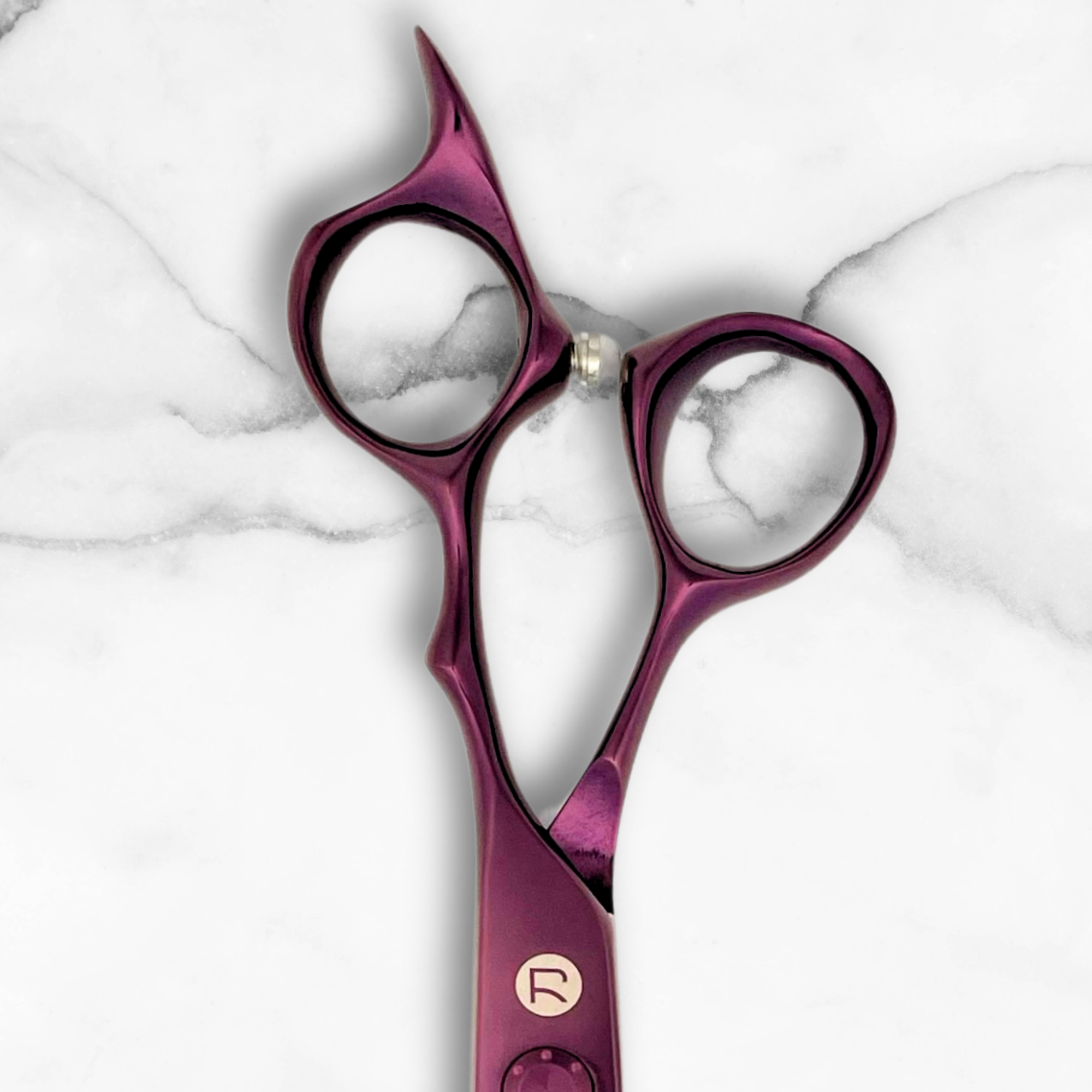
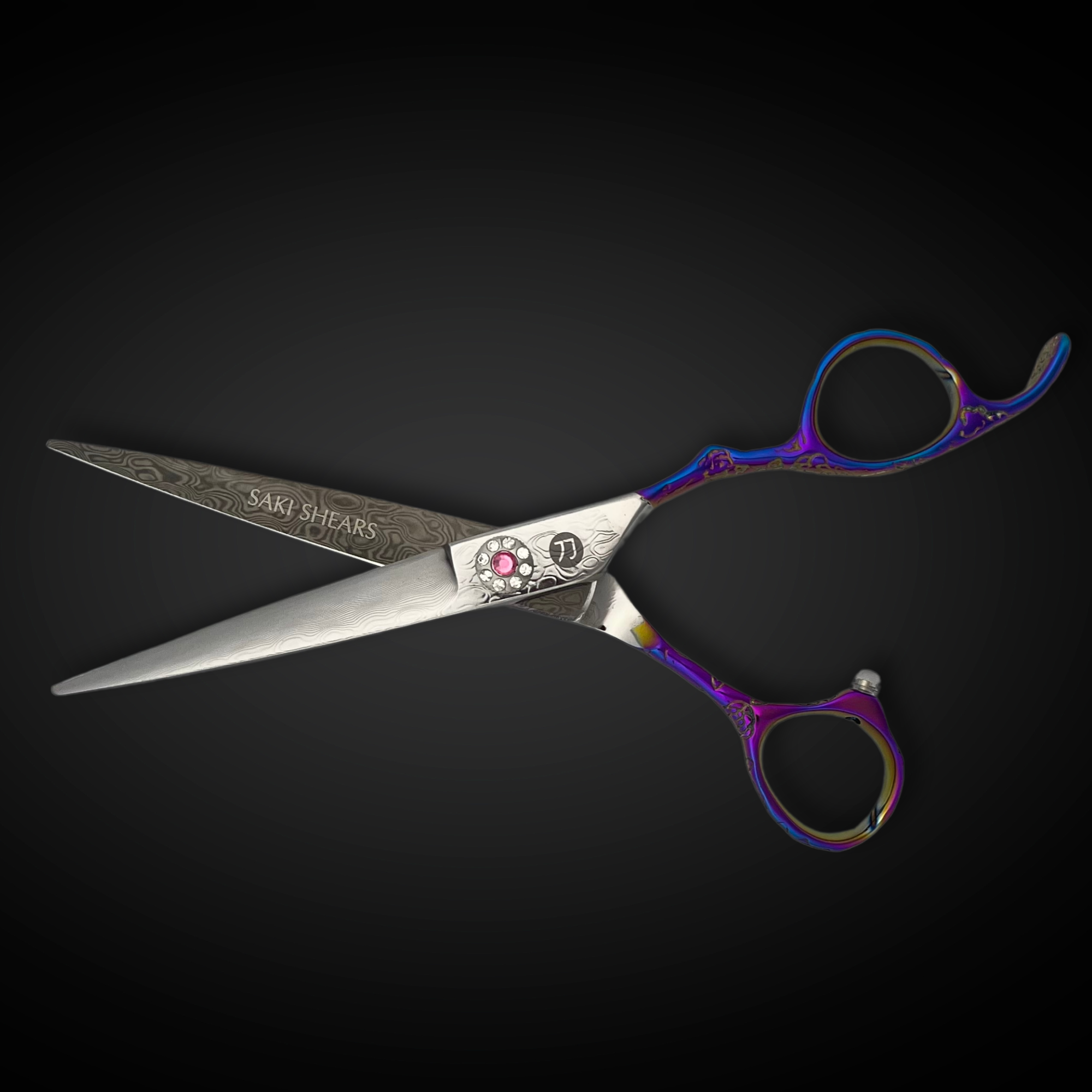
On a swivel shear, the thumb ring sits on a rotating joint. As you change blade angle — vertical for point cutting, horizontal for a blunt line, diagonal for a graduation — the ring pivots under your thumb instead of dragging your wrist along. The practical result: your wrist stays in its neutral, handshake position and your elbow drops toward your ribs, regardless of where the blade points.
That elbow drop matters as much as the wrist angle. A raised elbow loads the shoulder and traps tension up the entire arm; lowering it lets the shoulder girdle relax while the fingers do fine work. Because the elbow spends the whole day lower, the shoulder is often where the change registers first — before the wrist notices anything.
The trade-off is real, so let's name it: a rotating ring gives your thumb less rigid feedback than a fixed one. The first few cuts feel loose, like the shear is floating. Control comes back once your grip recalibrates — more on the adjustment period below — but a swivel is not a free upgrade. You trade a familiar locked-in feel for a mechanism that spares your anatomy, and you pay for that trade in practice time.

The Saki Sakura, Spec by Spec
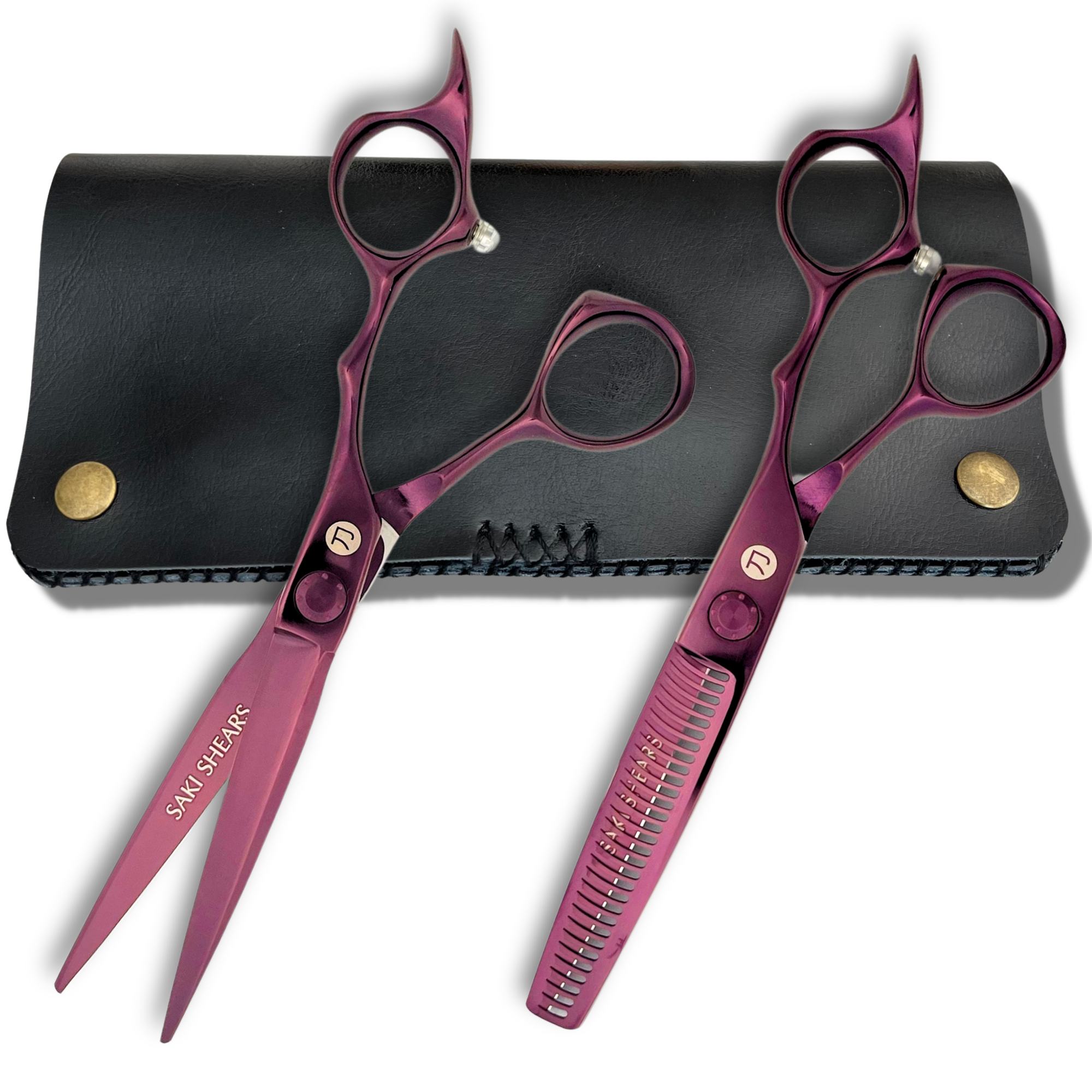
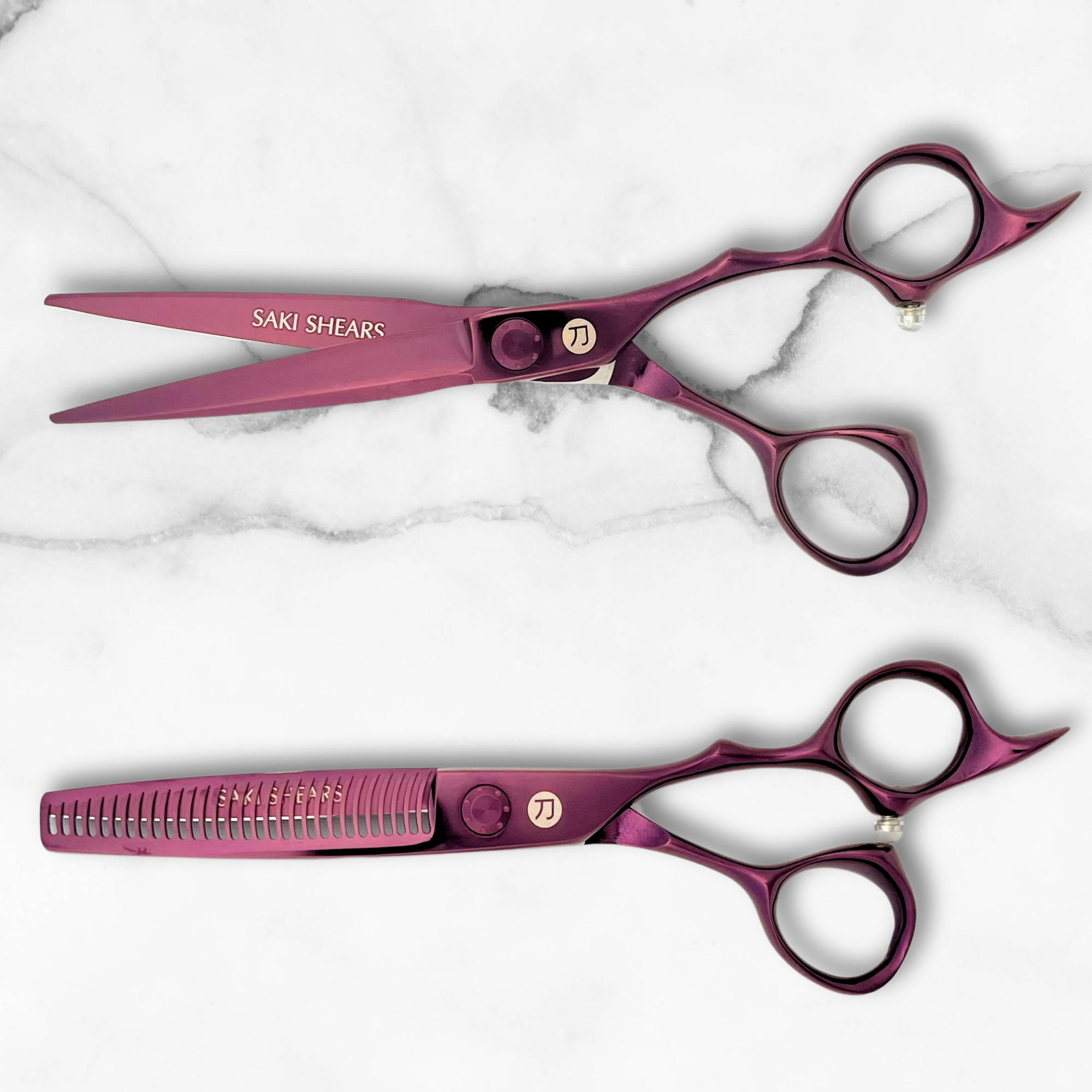
The Sakura is Saki's dedicated swivel cutting shear. The relevant numbers, all from the product's specification sheet:
| Spec | Sakura Swivel Cutting Shear |
|---|---|
| Steel | Japanese 440C stainless |
| Hardness | 60–61 HRC |
| Edge | Japanese-style convex |
| Length | 5.5 inches |
| Handle | Offset, single swivel thumb, 360° rotation |
| Construction | Handmade, two-piece welded |
| Price | $189, includes razor and leather case |
| Warranty | Saki Shears Lifetime Warranty |
Four of those specs deserve unpacking. First, 440C at 60–61 HRC holds a convex edge through months of daily work without pushing into the higher hardness ranges where steel gets brittle and edges chip — a practical balance for a shear that lives in a busy salon rather than a display case. Second, the 5.5-inch length is deliberate: swivel shears earn their keep in detail work — point cutting, precision lines around ears and napes — where blade angles change constantly and a shorter blade keeps you in control. If you mostly scissor-over-comb long sections, a longer fixed-thumb shear like the 6-inch Kotaro still makes sense as your workhorse. Third, the convex edge means the same slide-cutting and slice-cutting ability you'd expect from any Japanese-style shear — the swivel mechanism costs you nothing on edge performance. Fourth, two-piece welded construction — the blade steel welded to a separately made handle — is a large part of how a handmade 440C swivel shear lands under $200; fully forged one-piece construction drives prices considerably higher without changing what the edge does to hair.
The offset handle underneath the swivel does quiet work too. Offset alone shortens the thumb's travel and rotates the grip toward neutral; the swivel builds on that base rather than replacing it. You get both corrections at once.
Sakura vs. a Standard Offset Shear
Most working stylists aren't choosing between a swivel shear and nothing — they're choosing between a swivel and a conventional offset shear like Saki's Katana. Here's how they stack up:
| Factor | Sakura Swivel ($189) | Standard Offset, e.g. Katana ($199) |
|---|---|---|
| Wrist position | Neutral across most cutting positions | Neutral only at some angles; wrist flexes for the rest |
| Elbow height | Stays low across cutting positions | Rises for horizontal sections at or above eye level |
| Thumb feedback | Floating at first; firm after adjustment | Locked-in from the first cut |
| Learning curve | Days to a few weeks | None for experienced stylists |
| Steel and edge | 440C convex, 60–61 HRC | 440C convex, 60–61 HRC |
Note the last row: steel, hardness, and edge geometry are identical. The swivel decision is purely an ergonomics decision. You're not sacrificing cut quality either way — you're deciding how much strain your thumb and wrist absorb per haircut, and whether you'll invest the practice time the mechanism demands.
The Adjustment Period
Stylist forums and trade coverage converge on the same range: some stylists feel at home with a swivel thumb within their first day, most need somewhere between a few working days and a few weeks, and nearly everyone reports one specific early frustration — the thumb instinctively fights the rotation instead of letting the ring move. That fight is the old grip habit, not a flaw in the shear.
What speeds it up:
Start on low-stakes services. Use the Sakura for one or two forgiving cuts a day — a long trim, a one-length line you could do asleep — and keep your familiar shear in the holster for technical work. Expand as the floating feeling fades.
Loosen your grip on purpose. The mechanism only helps if you let the ring rotate. A death grip pins the swivel and recreates the fixed-thumb strain you paid to escape. Rest the thumb lightly; drive the blade from the pad, not the knuckle. If your hand aches at the end of a swivel day, that's the tell — you're still fighting the ring, and it's worth slowing your rollout for a week before the old habit re-cements itself on the new tool.
Check your tension screw. Hold one ring, open the blades to 90 degrees, and release the other handle: the blade should swing about a third of the way closed and stop. If it falls fully shut, the shear is too loose and will fold hair — tempting you into the hard squeeze that sabotages the swivel. If it barely moves, it's too tight and you'll muscle every closure. Set it right, then leave your grip out of it.
One caution worth stating plainly: if you already have diagnosed carpal tunnel syndrome or persistent numbness and tingling, a shear change supports treatment — it doesn't replace it. Median nerve compression that has progressed to constant symptoms needs a medical evaluation. The Sakura reduces the strain pattern going forward; it doesn't reverse nerve damage already done.
Who Should Switch — and Who Shouldn't
Switch now if you're feeling early warning signs: hand fatigue that outlasts the workday, occasional tingling after long clients, shoulder tightness from a chronically raised elbow. Early-stage strain is exactly where a mechanical fix pays off most, because you're changing the inputs before the damage compounds.
Switch strategically if you're symptom-free but heavy on detail work. Point cutting and precision bob lines involve constant blade-angle changes — every one of them is a wrist correction on a fixed shear and a ring rotation on a swivel. Prevention is an easier project than recovery, and the practice investment is cheapest while your hands still feel fine. The swivel isn't the only handle variable, either — our breakdown of how handle design affects hand and wrist fatigue covers offset angles and grip geometry, and the same logic applies here: the tool sets the ceiling, and your habits decide how much of it you collect.
Hold off if you're weeks away from a busy season with no slack for a learning curve, or if your work is overwhelmingly long scissor-over-comb sections where a longer blade matters more than angle flexibility. A swivel rewards stylists whose day involves varied angles; it offers less to a barber running clipper work with occasional shear finishing.
The Set Option: Cutting and Thinning on the Same Mechanism
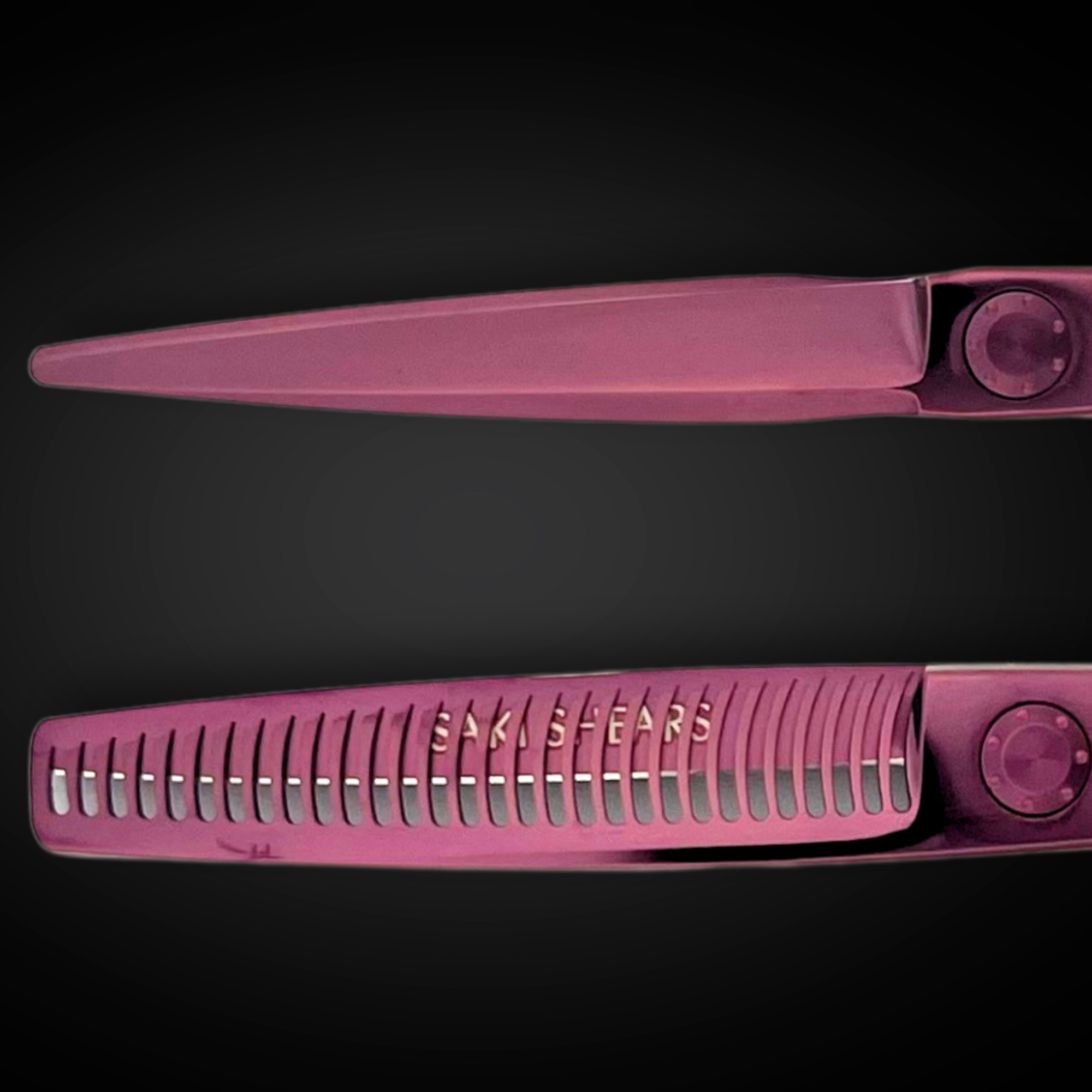
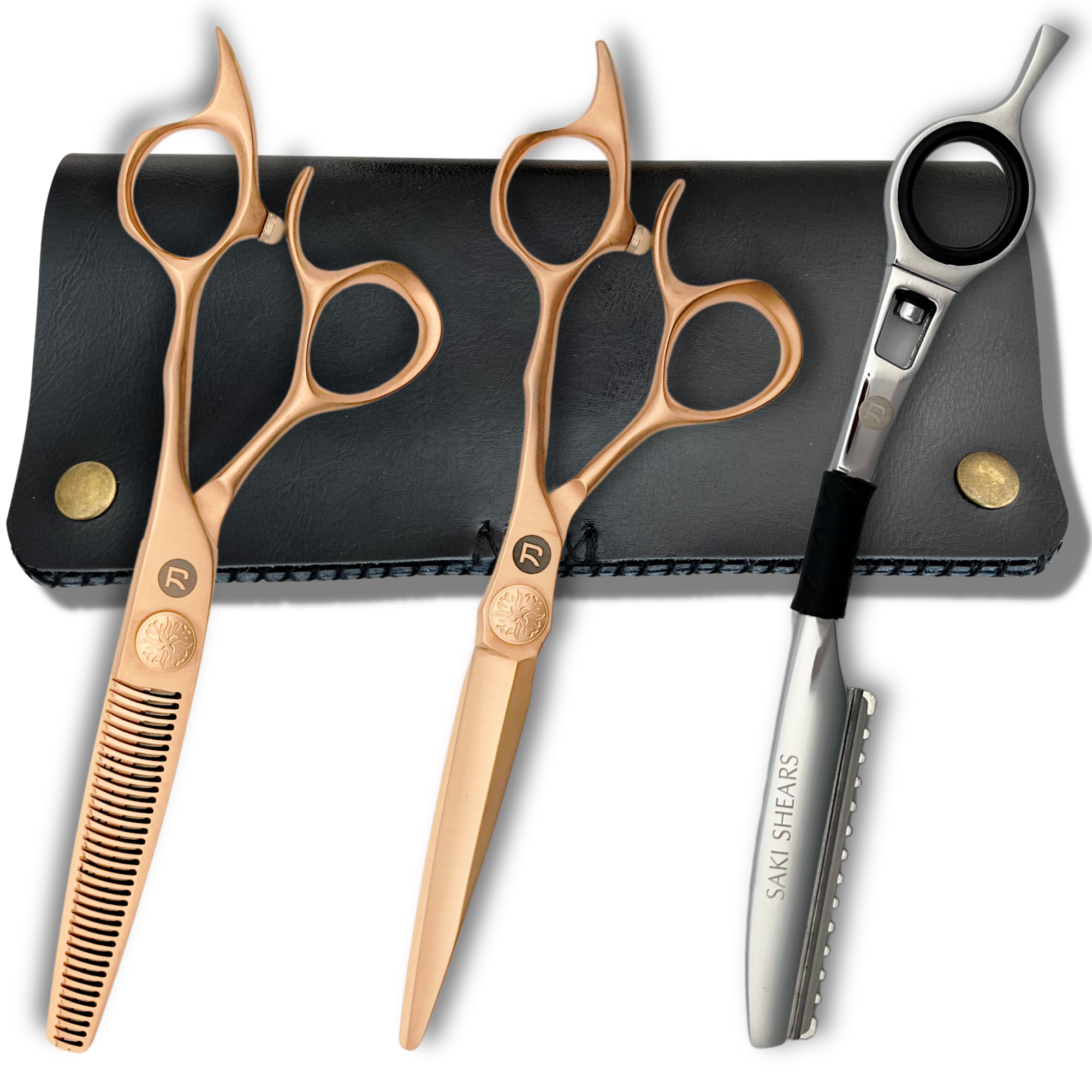
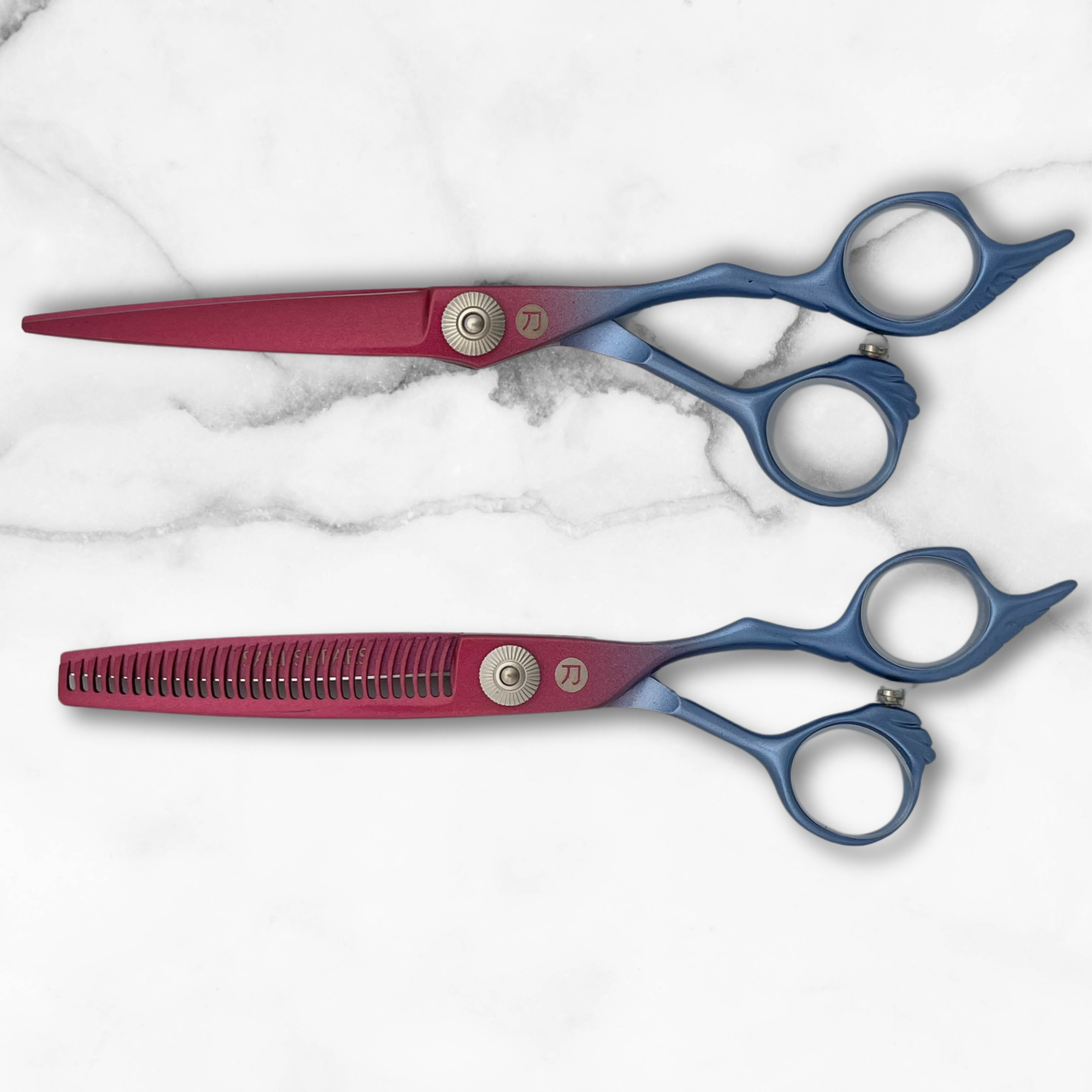
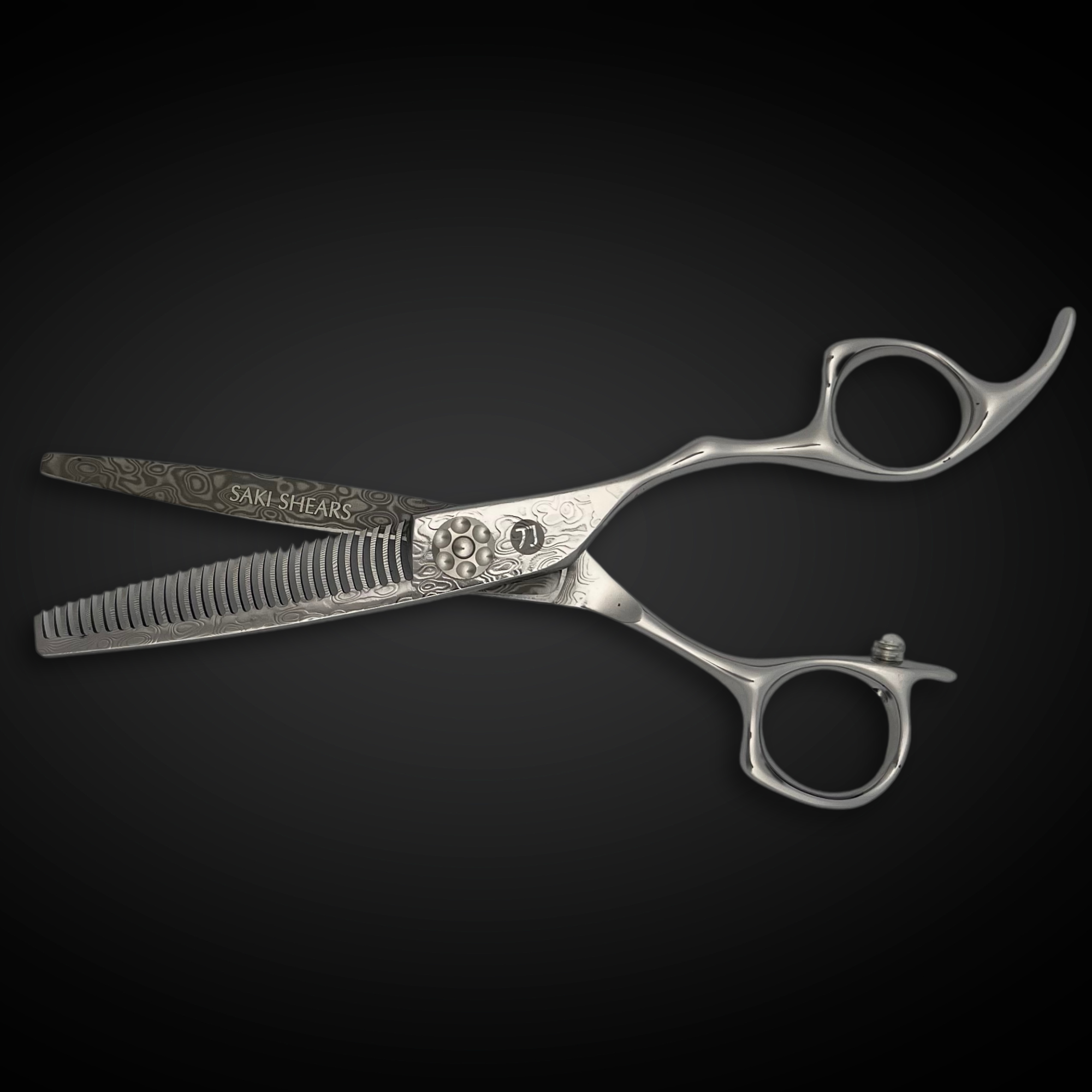
If the ergonomic argument convinces you, it applies to your thinning shear too. Every thinning pass is another closure driven by the same thumb, stacked on top of everything your cutting shear already demands that day — the tool changes, the anatomy doesn't. Saki builds the same swivel-thumb, offset-handle design into a 27-tooth, 5.75-inch thinning shear, sold separately as the Sakura thinning shear ($189) or bundled with the cutting shear in the Sakura Set.
The set runs $290 against $378 for the two shears bought separately — an $88 difference. There's a less obvious benefit than the price: switching between a swivel cutting shear and a fixed-thumb thinner mid-service forces your thumb to change habits every few minutes, which drags out the adjustment period. Matching mechanisms across both tools lets one grip habit serve the whole haircut.

Make the Tool Part of a System
A swivel shear removes strain from the grip. It can't fix the rest of the ergonomic picture, and pretending otherwise oversells the hardware. Three habits compound its effect. Keep your work at the right height: raise or lower the chair so most sections sit between your chest and chin, where your elbow can stay down. Break the static hold: between sections, drop both arms fully and let the shoulders release for a breath or two — static load is as damaging as repetitive load. Maintain your equipment: a dull or badly tensioned shear demands more closing force, and extra force is precisely what an aching hand can't afford.
Picture the difference across one Saturday. Eight clients, and on a fixed-thumb shear every section above the ears sends your elbow up toward shoulder height — dozens of raises you stop noticing until the drive home. With the chair pumped to the right height and a thumb ring that rotates instead of resisting, most of those raises never happen at all. None of it feels dramatic in the moment. The payoff is what your hands feel like in October, not at 3 p.m.
FAQs
Do swivel shears really help with carpal tunnel?
They address the mechanical risk factors — sustained wrist flexion, raised elbow, repetitive thumb force — that occupational health research links to carpal tunnel syndrome in hairdressers. That makes them a strong preventive tool and a sensible part of managing early symptoms. They are not a treatment: established median nerve compression needs medical evaluation, and no shear reverses existing nerve damage.
How long does it take to get used to swivel shears?
Expect anywhere from one day to a few weeks, depending on how many cuts you do and how willing you are to loosen your grip. The consistent pattern: stylists who let the ring rotate adapt in days; stylists who fight the rotation with a tight thumb take weeks. Start with one or two simple services a day and expand as it feels natural.
Are swivel shears worth it if I don't have wrist pain yet?
If your career plan involves cutting hair for another decade, yes — repetitive strain accumulates quietly, and hairdressing has documented elevated rates of hand and wrist disorders. The strongest case is for stylists doing angle-heavy detail work. The counterargument: if your work is mostly long straight sections, the ergonomic gain is smaller and a conventional offset shear may serve you fine.
The Bottom Line
Carpal tunnel risk in hairdressing is a documented occupational reality, and the fixed thumb ring is a real part of the mechanism. The Sakura swivel shear fixes the input — neutral wrist, lowered elbow, lighter thumb — with the same 440C convex-edge steel as a conventional Japanese shear, at $189 with a lifetime warranty. What it asks in return is a short stretch of deliberate practice. For a working stylist whose hands are the entire business, that's a favorable trade. The full specifications are on the Sakura product page.