Articolo: Convex Edge vs Beveled Edge Blades: What Every Stylist Should Know
Convex Edge vs Beveled Edge Blades: What Every Stylist Should Know
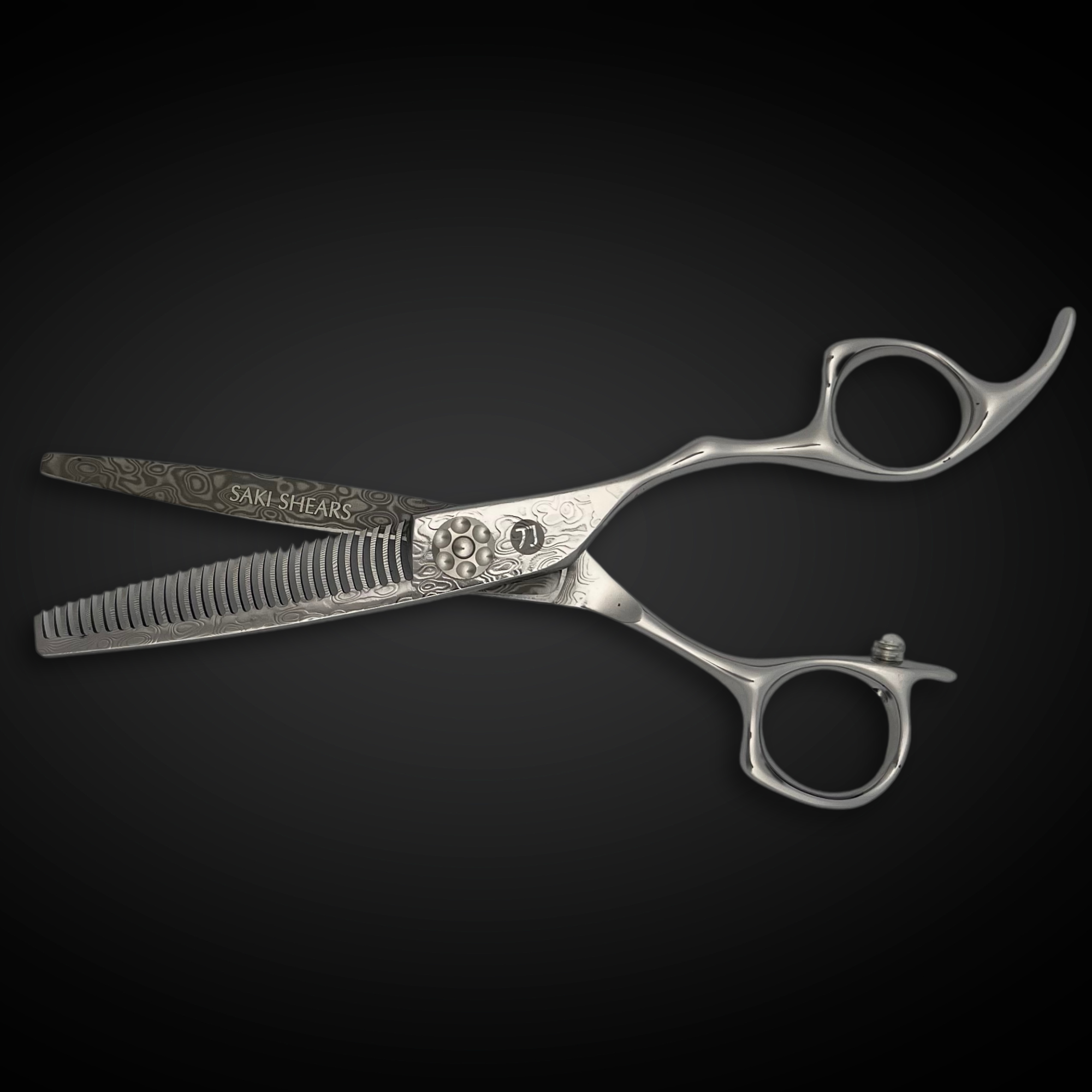
Every shear on your station has one of two edge geometries, and that geometry decides more about your day than the brand name on the blade. A convex edge slices; a beveled edge shears and grips. That single difference determines which techniques feel effortless, how the cut ends look under magnification, how often you pay a sharpener, and what happens the first time the shears hit the floor. Every Saki shear is convex — from the Kotaro 6-inch 440C cutting shears at $189 up to the VG10 cobalt models. Most beauty-school shears are beveled. This article covers what each geometry actually is, which techniques each supports, where each fails, and how to tell what you currently own.
One note before the comparison: neither edge is "the good one." A beveled edge on thick, coarse hair in a high-volume barbershop is a defensible choice. A convex edge in the hands of a stylist who slide cuts all day is the obvious one. Match the edge to the work.
What Edge Geometry Means on a Hair Shear
Look at a blade in cross-section — as if you sawed it in half and looked at the cut face. A beveled edge is ground flat: near the cutting edge, the maker grinds a distinct flat facet that meets the inside face of the blade at an angle. You can usually see it as a visible line of light — a hone line — running along the outside of the blade. Many beveled shears also carry micro-serrations on one blade: fine teeth that grip the hair so it can't slide away from the closing blades.
A convex edge has no flat facet. The outside face of the blade curves continuously from the spine down to the cutting edge, finishing in a much finer apex. The inside of the blade is hollow-ground, so the two blades touch only along a narrow contact line — the ride line — as they pass each other. The result is a thinner, more acute edge with far less steel meeting the hair at the moment of the cut. The short version: convex is the sharper, smoother-cutting geometry; bevel is the tougher, more forgiving one.

Why does the cross-section matter? Because hair doesn't just get cut — it gets compressed first. As the blades close, the hair shaft is squeezed between two steel faces until the edge parts it. A fine convex apex parts the shaft almost immediately, with minimal compression. A thicker beveled edge compresses the shaft longer before it severs, and a dull one bends the hair over the edge before tearing through it. Compression is the difference between a cleanly cut end and a frayed one — which is why clients with fragile or chemically treated hair notice the difference at their next wash.

The Convex Edge: Built to Slice
A convex edge cuts with a slicing action rather than a crushing one. Close the blades slowly on a dry section and the hair offers almost no resistance — no push, no bend, no sound beyond a soft shear. A whole family of techniques simply doesn't happen without that glide. Slide cutting, slicing, and channel cutting all involve moving partially open blades along the hair shaft. With a convex edge, the blade travels and removes hair progressively. With a serrated bevel, the teeth grab and hold — the shear stalls, the hair snags, and the client feels it.
Dry cutting exposes the same difference. Dry hair is stiffer and less forgiving than wet hair, and every flaw in the edge shows up as a pushed or chewed section. This is why dry-cutting specialists work almost exclusively with convex blades.
The trade-offs are real, and anyone selling convex shears should say them plainly:
The apex is delicate. A finer edge means less steel supporting the cutting line. Drop a convex shear on a tile floor and the edge can roll or chip in a way a thick bevel would shrug off. Cutting over clips, bobby pins, or grit does the same damage faster.
Sharpening is specialist work. A convex edge cannot be restored on flat equipment — a curved surface can't be trued against a flat stone, which is the same reason convex knife grinds need a yielding abrasive rather than a bench stone. A sharpener who clamps your shears into a flat-hone system will grind a facet into the curve, permanently converting the convex edge into a crude bevel; repairing that means regrinding the entire curve and giving up a measurable amount of blade life. Expect convex service to cost more than flat-grind work, and often to mean mail-in turnaround. Before you hand your shears to anyone, ask one question: "Do you sharpen convex edges on convex equipment?" If the answer involves hesitation, walk away.
Harder steel is non-negotiable. A fine apex ground into soft steel folds within weeks. That's why real convex shears are made from hardened Japanese cutlery steels — 440C stainless hardens to roughly 58–60 HRC with around 1% carbon and 16–18% chromium, per the published 440C specification.

VG10 cobalt steel takes that further, hardening to HRC 60–61 in the Grand Master and Gold lines. If you want the full metallurgy, the trade-offs are covered in VG10 vs 440C: which makes better hair shears.
The Beveled Edge: Built to Endure
The beveled edge is the older, European grind, and it survives for good reasons. More steel behind the cutting line means the edge tolerates abuse: coarse hair, high daily volume, the occasional drop. The micro-serrations found on many beveled shears solve a genuine problem — slippery, blunt-cut sections stay put instead of sliding toward the tip — which is why beveled, serrated shears remain common in barbering and in shear-over-comb work where hair control matters more than glide.
Sharpening is also simpler economics. A flat grind can be serviced by nearly any competent sharpener with standard equipment, typically at a lower price than convex work. For a busy shop running several pairs hard, that maintenance math is worth something.
The costs sit on the other side of the ledger. A beveled edge is thicker, so it compresses hair more before cutting — acceptable on a strong blunt line, visible on soft, fragile, or chemically processed hair. Serrations make slide cutting effectively impossible: the teeth are designed to stop hair from moving along the blade, which is precisely the motion slide cutting requires. And the feel is different: a bevel cuts with a definite mechanical bite rather than a glide, which many barbers actively prefer for control work and most precision cutters eventually move away from.
Convex vs Beveled at a Glance
| Feature | Convex edge | Beveled edge |
|---|---|---|
| Cross-section | Continuous curve to a fine apex; hollow-ground inner face | Flat ground facet with visible hone line; often micro-serrated |
| Cutting action | Slices with minimal hair compression | Shears with a mechanical bite; serrations grip the hair |
| Best-fit techniques | Slide cutting, slicing, dry cutting, point cutting, precision lines | Blunt cutting, shear-over-comb, student blade-control work |
| Durability | Fine apex; vulnerable to drops, clips, and grit | Thick edge; tolerant of coarse hair and rough handling |
| Sharpening | Convex-trained sharpener with convex equipment only | Any competent sharpener with standard flat equipment |
| Typical steel | Hardened Japanese steels — 440C (58–60 HRC), VG10 cobalt (60–61 HRC) | German-style stainless; the thick grind works fine in steel softer than a convex apex demands |
Edge geometries compared. HRC figures: published 440C specification and Saki product data.
Match the Edge to the Technique, Not the Other Way Around
Blunt and club cutting. The real difference here is hand demand. A serrated bevel holds the section against the blade on slippery, freshly washed hair, so the line stays true with less effort. A convex edge produces a marginally cleaner end but asks for better tension control from your hand, since nothing is gripping the hair for you. Either edge finishes the job.
Point cutting. Convex wins, though a sharp bevel is workable. Point cutting concentrates work in the last third of the blade, and a fine convex tip enters the section without pushing hair ahead of it. Blade length matters as much as edge here — tip work favors shorter shears, a decision covered in the 5.5 vs 6 vs 7 inch shear size guide.
Slide cutting and slicing. Convex only. This is not a preference; it is mechanics. The technique requires hair to move along a partially open blade, and serrations exist to prevent exactly that movement. Forcing it with a beveled shear pulls hair at the root — the fastest way to lose a tender-headed client.
Dry cutting. Convex, strongly. Dry hair magnifies edge flaws, and the compression of a thicker bevel shows up as visible fray across the finished surface.
Shear-over-comb. Both work. Many barbers prefer a longer beveled shear for the hair control; stylists from a precision background reach for a long convex blade and rely on speed and rhythm instead of serration grip.
How to Tell Which Edge You Own
Three checks, thirty seconds:
Look at the outside face. Tilt the open blade under a light. A beveled edge shows a distinct band of reflection — the flat facet — running parallel to the cutting line. A convex edge shows one smooth, uninterrupted curve of light from spine to edge, like the side of a polished spoon.
Listen and feel on a slow close. Close the blades slowly on air. Serrated bevels produce a faint dry friction you can feel in the thumb ring. A properly tensioned convex pair closes silently, riding only on the ride line. Confirm the tension itself is right while you're there — a loose pivot makes any edge fold hair, and the test takes seconds; the method is in this guide to adjusting shear tension correctly.
Run a fingernail across the inner edge — gently. Serrations register as fine ridges. A convex edge feels like polished glass. Do this once, lightly, away from the apex.
One complication: a lot of mid-market "Japanese-style" shears are actually semi-convex — a hybrid grind with a small flattened zone behind a curved face. If the light test gives you an ambiguous result, that's probably what you own. Treat semi-convex as convex for sharpening purposes, and expect cutting behavior between the two: smoother than a serrated bevel, without the full glide of a true convex apex.
Choosing a Convex Shear Across the Range
Once you've decided on convex, the remaining variables are blade length, handle design, steel, and price. Here is how the Saki line sorts out, so you can see what each step up actually buys:
| Shear | Steel | Price | Best fit |
|---|---|---|---|
| Kohana 5.5" | 440C, titanium coated | $145 | First convex pair; detail and tip work |
| Tomika 5.5" | 440C | $180 | Students and precision detail cutting |
| Kotaro 6" | 440C | $189 | All-around daily cutting; the default choice |
| Sakura swivel | 440C | $189 | Long dry-cutting sessions; thumb and wrist strain |
| Katana 6" | 440C | $199 | Heavier daily use; blunt lines and slicing |
| Grand Master 6" | VG10 cobalt | $269 | Maximum edge retention between sharpenings |
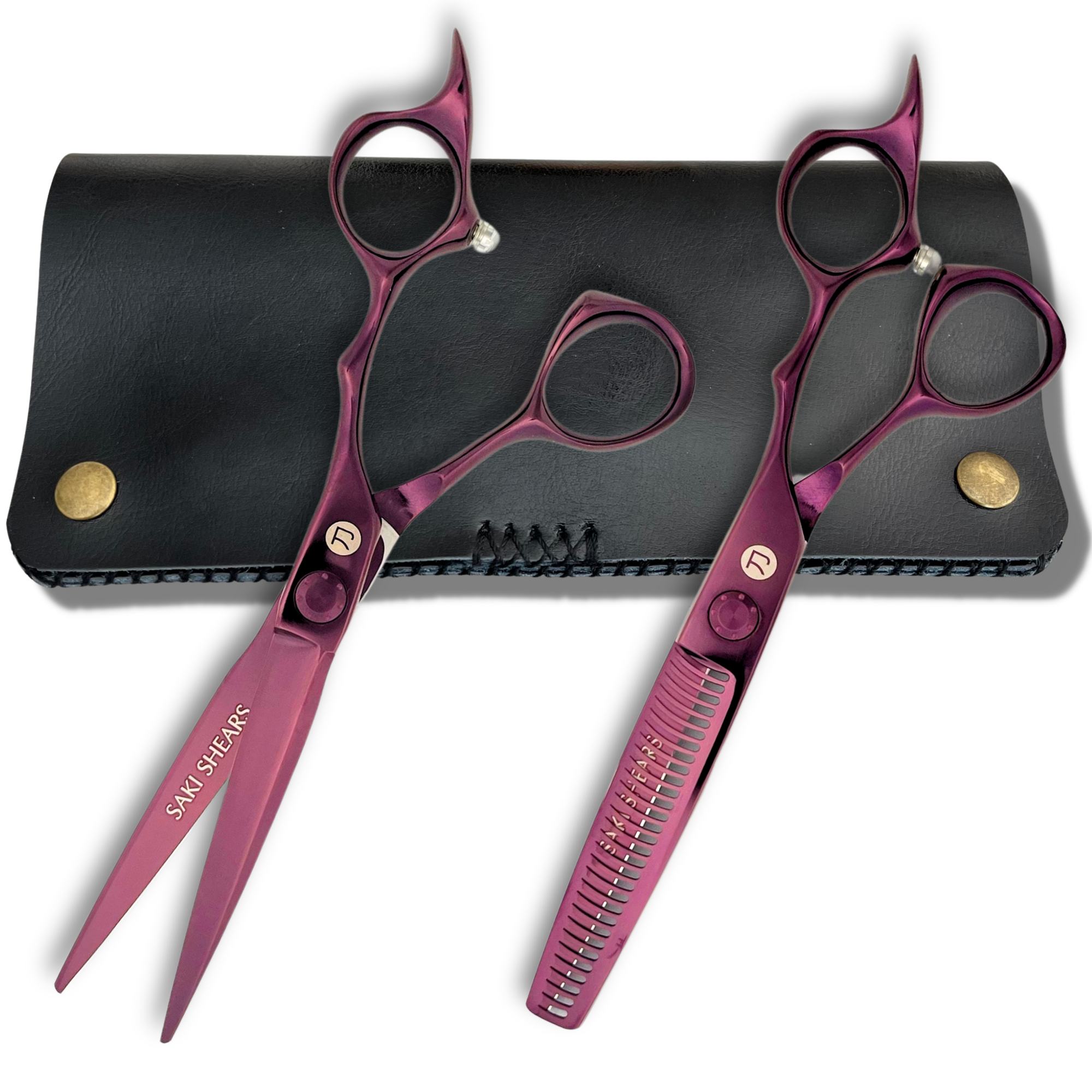
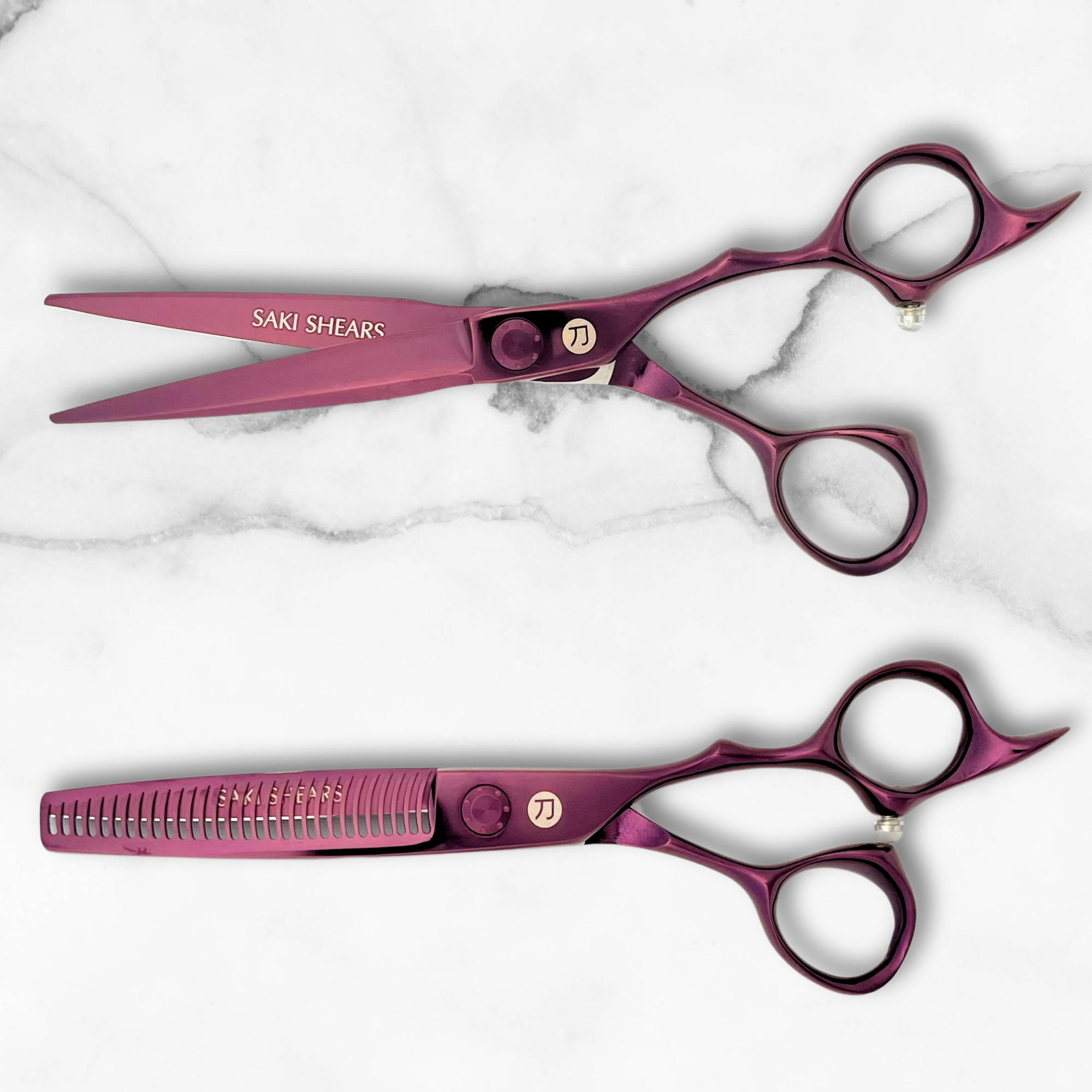
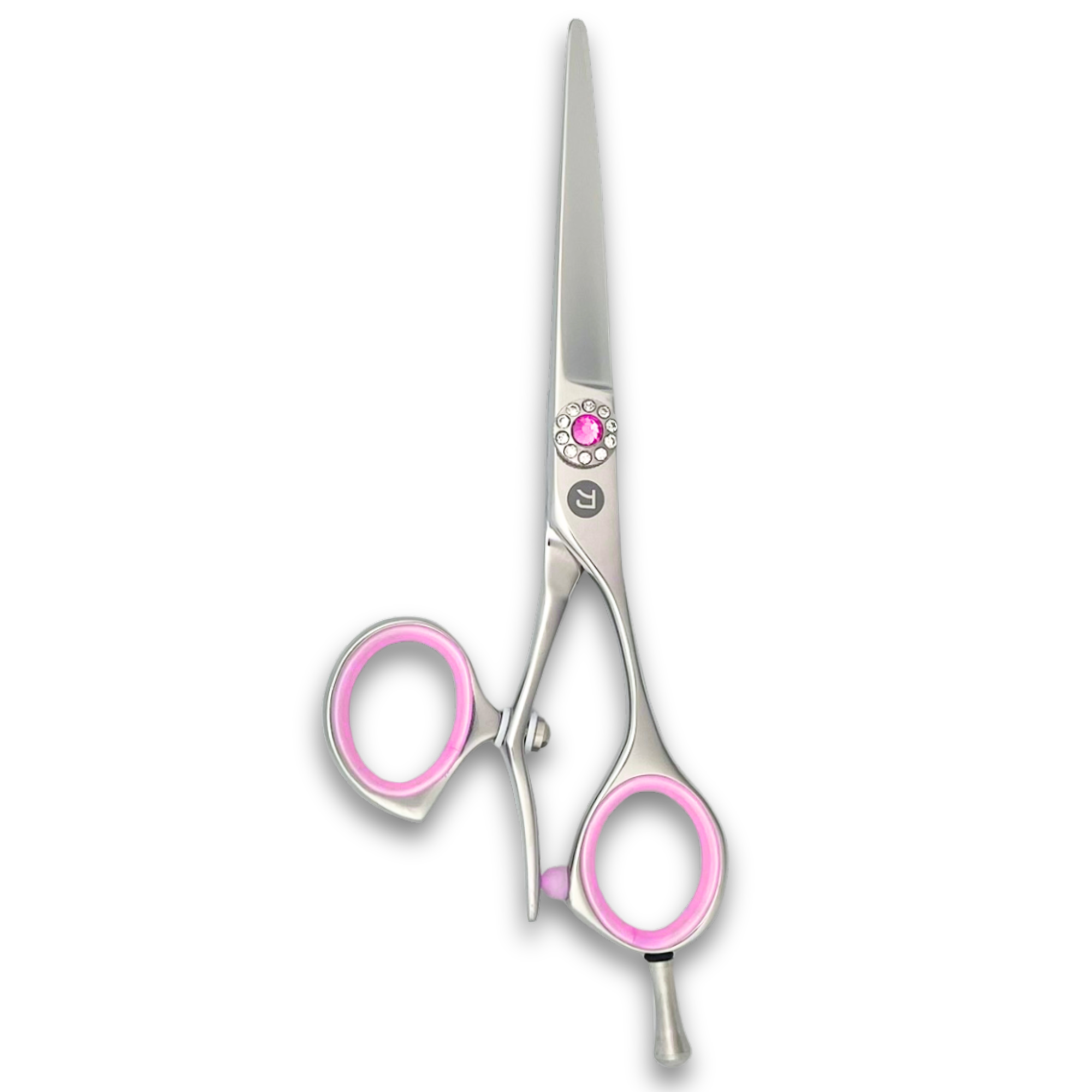
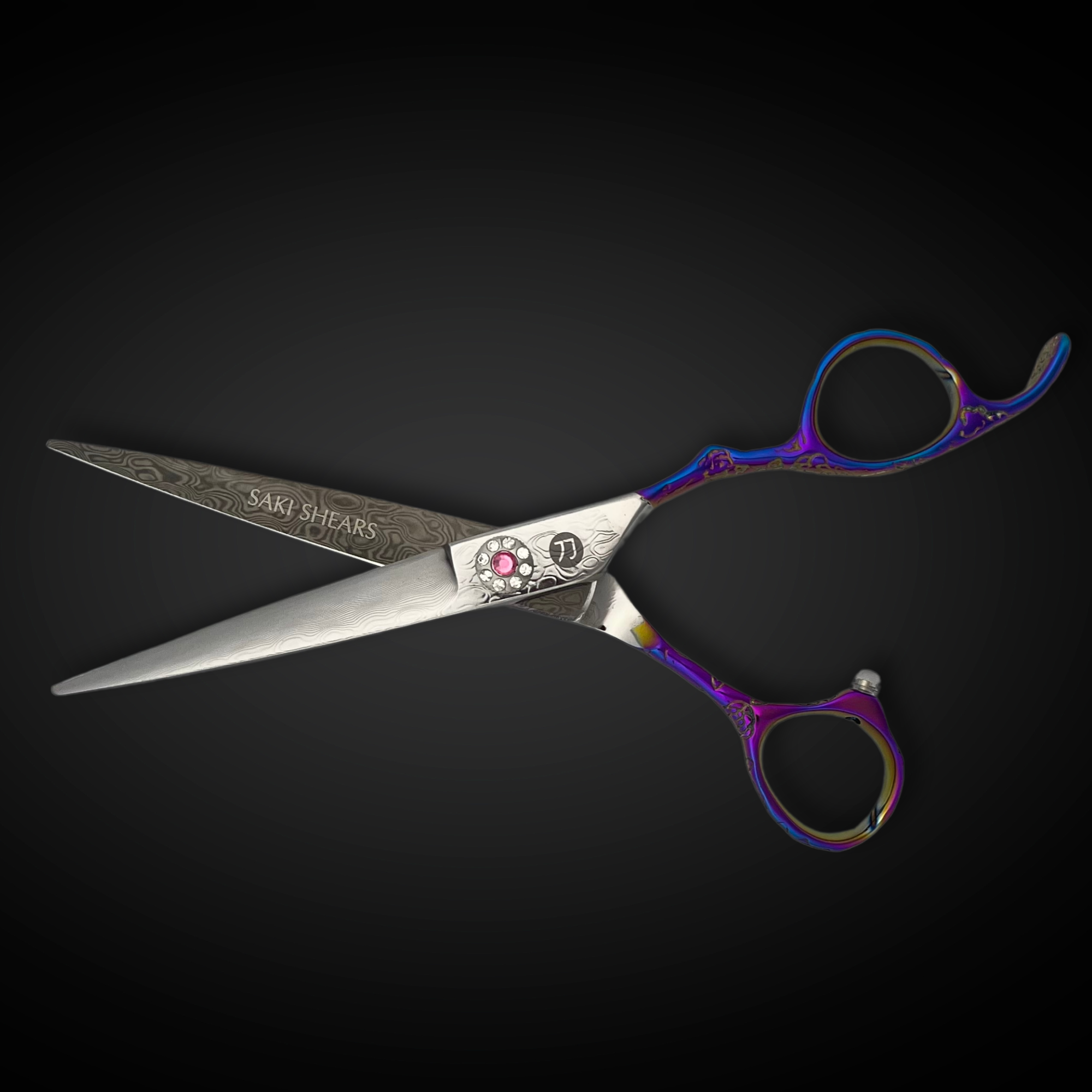
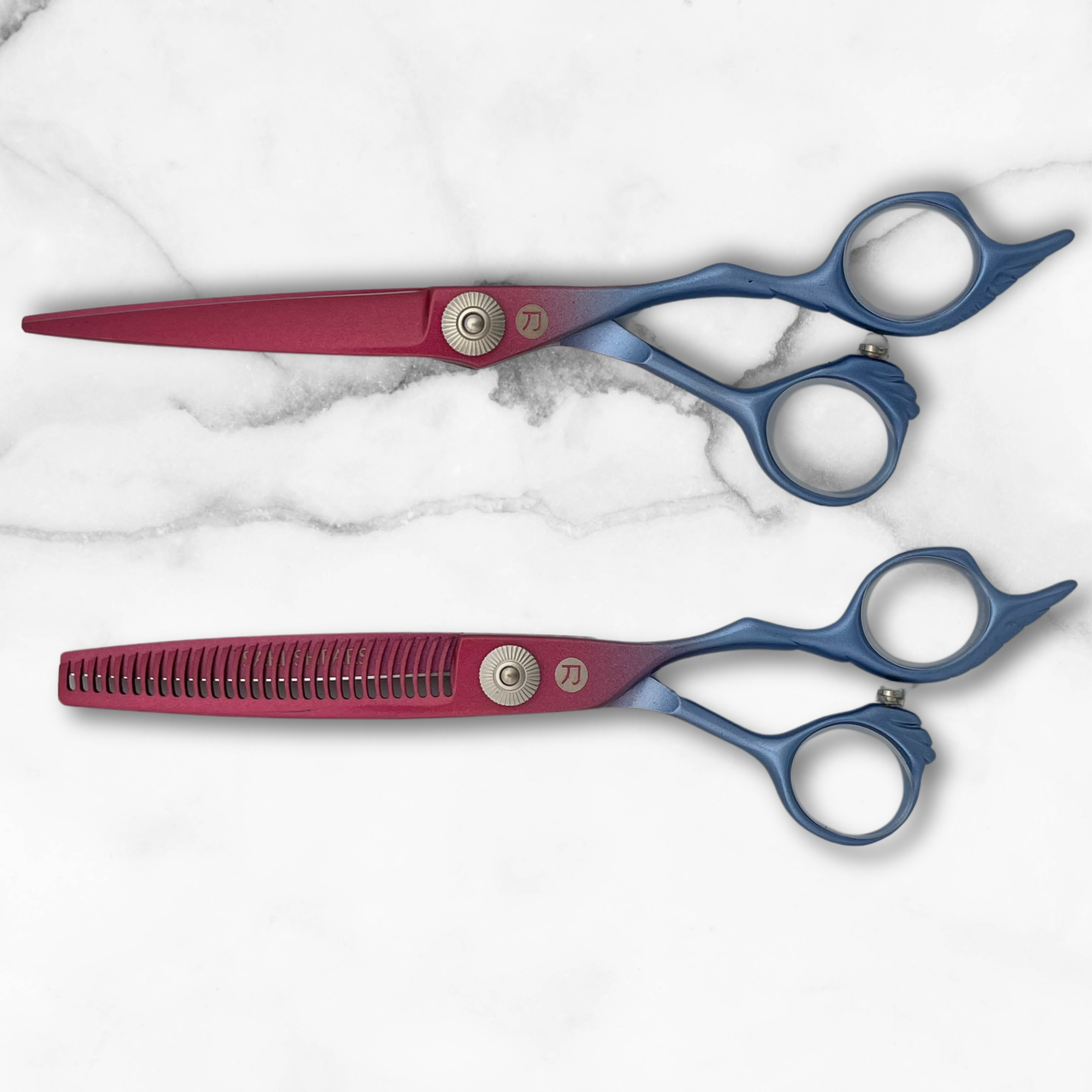
Cutting shears across the Saki range; matching cutting-and-thinning sets run $265–$350.

A few things worth saying plainly about that table. The geometry is identical across every row — a $145 Kohana and a $269 Grand Master are both fully convex, so both slide cut. What you buy going up the range is edge retention, finish, and handle refinement, not a different cutting capability. Steel is the biggest single jump: VG10 cobalt holds its apex longer than 440C, which shows up as fewer trips to the sharpener rather than a different feel on day one.
Blade length is the second decision. The 5.5-inch Tomika favors detail work around the ears and perimeter; the 6-inch Kotaro and Katana move through heavy sections faster. Most stylists who cut full-time end up owning both lengths rather than compromising on one.
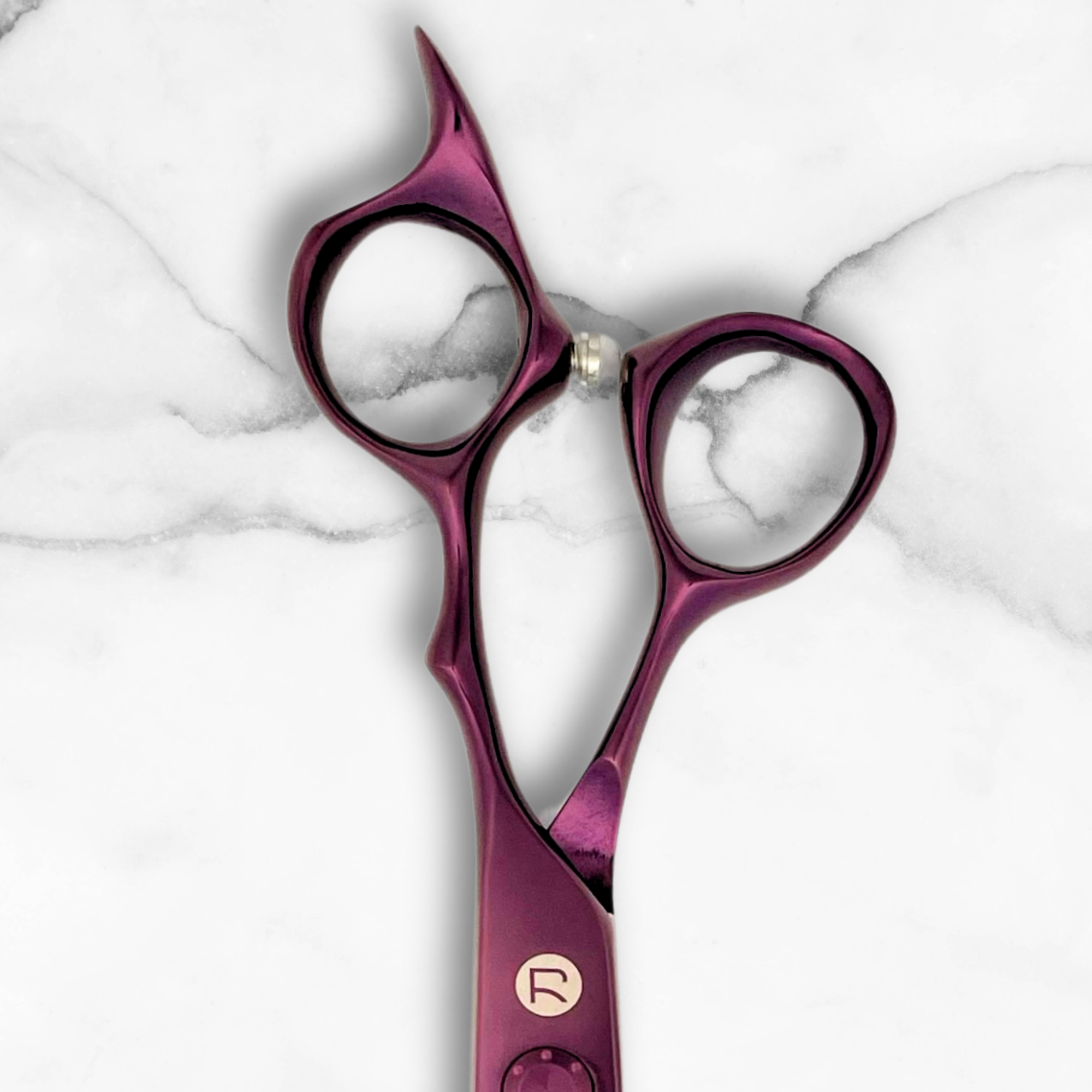
Handle design deserves attention too, and it interacts with edge geometry more than spec sheets admit. A convex shear used for long dry-cutting sessions rewards an ergonomic grip, since you're carrying the shear through more continuous motion. The Sakura swivel takes that furthest by letting the thumb ring rotate, which keeps the wrist neutral through slide cutting; the broader comparison is in offset vs crane handle shears.
A beveled edge still earns its place when durability is the dominant constraint: a student learning blade discipline, a barber pushing high volume through coarse hair, or a backup pair for the days your primary shears are out for sharpening. None of that is a compromise on professionalism.
Care Differences That Actually Matter
Here is the care point that matters most and gets said least: a dull convex edge used for weeks doesn't just cut badly — it trains you into compensating hand habits (over-gripping, forcing the close, tilting the blade) that persist long after the shears come back sharp. When performance drops — hair folding at the tip, push at the pivot end — stop cutting with that pair, send it to a convex-qualified sharpener, and run your backup. The interval depends on your cut volume, your dry-cutting share, and the hair types in your book; heavy dry cutters need service noticeably sooner than low-volume stylists.
Beyond the routine you already run (wipe-down after every client, pivot oil at close, a case rather than a drawer), the margins favor extra caution with convex: never cut anything but clean hair, since grit, product buildup, and the occasional hidden bobby pin damage a fine apex disproportionately, and never lay shears blade-down on a hard station. If the pivot feels off, check it before blaming the edge — a loose pivot makes any geometry fold hair.
The Bottom Line
Convex edges slice with minimal compression and are the entry ticket to slide, slice, and dry-cutting work — paid for in delicacy, specialist sharpening, and harder steel. Beveled edges grip and endure — paid for in glide and end-quality on fine or fragile hair. Most working stylists land on a convex primary pair with a durable backup, matched to the techniques that actually fill their book. If you're moving to a convex primary, the 6-inch Kotaro at $189 is the most broadly useful starting point in the Saki range; the Grand Master in VG10 cobalt is the choice when time between sharpenings matters more than price.
Frequently Asked Questions
Are convex shears worth the extra money?
If you slide cut, slice, or dry cut — yes, because those techniques don't work properly on serrated beveled edges. If you exclusively blunt cut and prioritize durability and cheap sharpening, a quality beveled shear is a rational choice. The value question is really a technique question.
Do beveled shears damage hair?
A sharp beveled shear cuts cleanly enough for blunt work. The thicker edge does compress hair more before severing it than a convex edge does, which can show as slightly frayed ends on fine or chemically treated hair — and a dull bevel bends hair over the edge before tearing it. Sharpness matters more than geometry for hair health; geometry decides the ceiling.
Can any sharpener service convex shears?
No. Convex edges must be sharpened on convex-specific equipment by someone trained on the geometry. A flat-hone sharpening will grind a facet into the curve and permanently degrade the edge into a rough bevel. Always ask a sharpener directly whether they sharpen convex edges on convex equipment before handing over your shears.